Against Batumi Riviera

2018

This AI-generated translation may not be completely accurate.
Against Batumi Riviera
The company Silk Road Group planned to build six new buildings in Batumi, next to the Chacha Tower. The tallest among them — a 42-story, 130-meter-high aparthotel called Silk Tower — was intended to replace the previously announced Trump Tower project from 2012. The plan also included hotels, residential apartments, and retail spaces. The project, titled Batumi Riviera, was officially presented on December 17, 2018, at the Radisson Blu Hotel in Batumi, with company founder and chairman Giorgi Ramishvili in attendance.
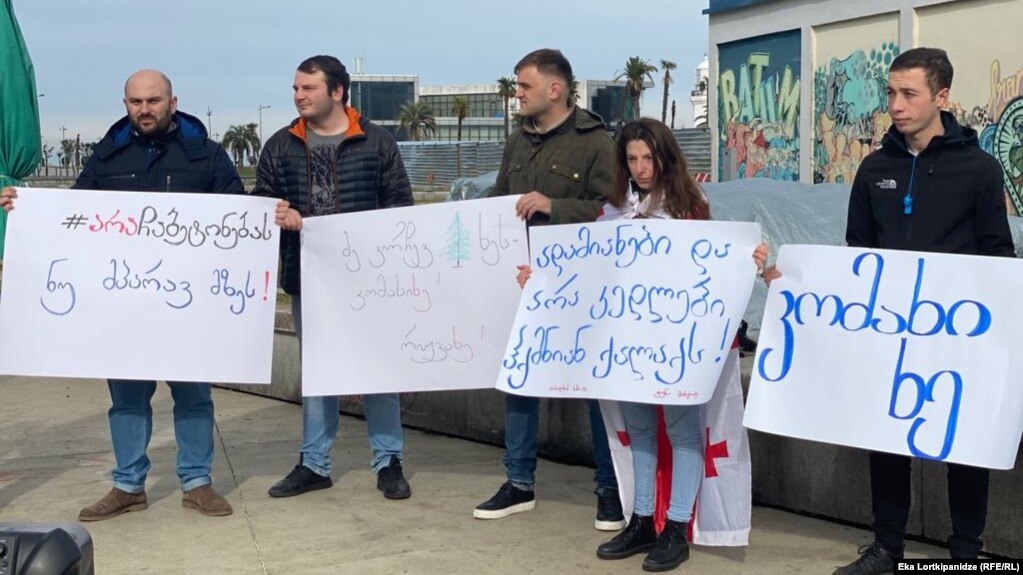
From the outset, the civic organization Batomi opposed the project. At that time, the National Agency for Cultural Heritage Preservation of Georgia was working on approving protection zones for Batumi’s historic districts, and the planned construction area was under dispute. If the territory were to be included in the historic preservation zone, city-planning parameters such as building height and density would be restricted. Batomi’s representatives argued that large-scale urban projects like this required transparent decision-making and broader public participation rather than mere announcements on the City Council’s website or in the Adjara newspaper.
On December 31, 2018, at exactly midnight, Batomi and other local activists held a protest action titled “No to Overdevelopment!” (არა ჩაბეტონებას!) at Europe Square — the same site where the city’s New Year’s gala concert was taking place.
Opponents of Batumi Riviera voiced two major concerns:
- The area forms part of the city’s historic center and should be under cultural protection.
- Construction of high-rise buildings in this zone poses significant environmental and geological risks.
A 2013 UN-funded study on Adjara’s Climate Change Strategy warned that large-scale construction near Batumi’s cape could trigger landslides and shoreline erosion due to the region’s fragile geological structure.
Activists from Batomi, Green Alternative, and the movement Protect Batumi called on the Georgian Prime Minister to conduct a full environmental impact assessment before allowing construction to proceed.
The protests later spread to Tbilisi. On January 20, 2020, activists displayed a large banner reading “No to Concrete Slavery” (არა ბეტონ-ყმობას) on the bridge near the House of Justice. They argued that the project would “completely cement” Batumi, destroying the city’s last public access to the sea.
On February 15, 2020, protesters planted green saplings near the construction fence at the Riviera site, demanding that the six-hectare territory remain a recreational zone. Their banners read: “Don’t steal our sunlight” and “People, not walls, make a city.”
When the COVID-19 pandemic and national state of emergency began in March 2020, public demonstrations were suspended.
On January 22, 2021, the Georgian Young Lawyers’ Association (GYLA), together with Batumi activists, filed a lawsuit in Tbilisi City Court seeking to revoke the construction permit issued by the Ministry of Economy in 2019. The City Court dismissed the claim, but the Court of Appeals later overturned that ruling and instructed the lower court to reconsider the suspension of the permit.
On July 1, 2021, Tbilisi City Court once again reviewed the case but maintained its previous decision, allowing the permit to stand.
As of February 1, 2024, media reports indicated that the Batumi Riviera project had been scaled down: instead of five towers, the developers planned to build three, with the tallest now reaching 240 meters. The city’s land-use plan was accordingly amended to reflect the new design.