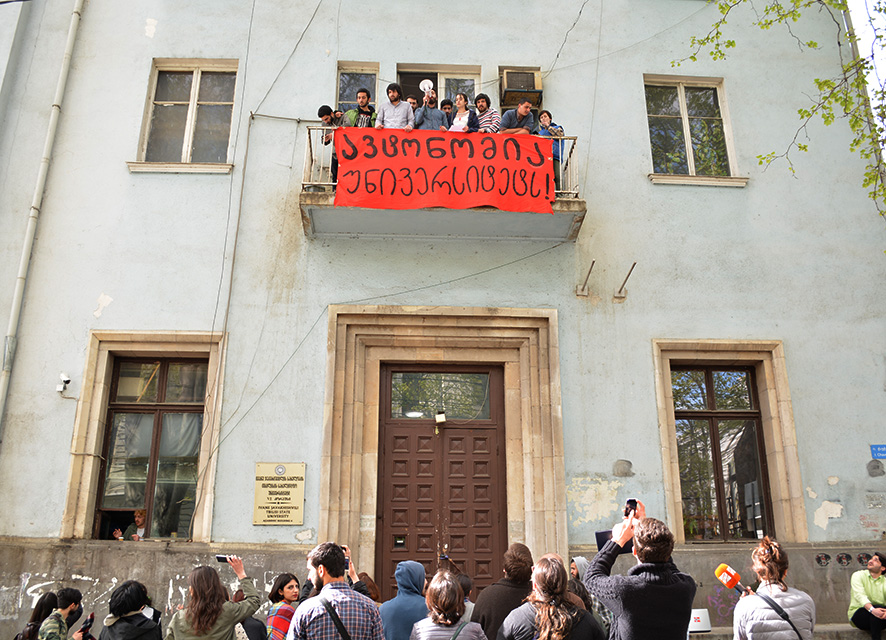
Autonomy to the university!

2016

This AI-generated translation may not be completely accurate.
Autonomy to the university!
On April 16, 2016, the protest of Tbilisi State University students began in the morning with the occupation of the university’s sixth building. The students locked the doors from the inside and barricaded them with desks, while the security staff could not resist. At the same time, protests continued outside the building:
“Autonomy for the university! Autonomy for the university! Priority to science! Priority to science!” – the students chanted.
The main demand of the protest organized by Auditorium 115 was a complete transformation of the system and the implementation of fundamental education reform. The students declared that, despite earlier promises, the Ministry of Education had not met their key demands and had failed to create an equal and free environment in educational institutions. Therefore, the members of Auditorium 115 announced that they no longer trusted the ministry and called for the prime minister’s intervention. The last meeting to discuss and coordinate these principles was held with Minister of Education Tamar Sanikidze on April 13.
“They deceived us when the minister and deputy minister promised that amendments would be made to the Law on Education in accordance with our principles. They thought the momentum would fade. They offered us even worse models. We are not alone in this struggle. Students from other universities in Tbilisi are joining us.”
The principles mentioned by student Nodar Etsadashvili and presented to the Ministry of Education on behalf of Auditorium 115 were as follows:
- Complete reform of the education system and prioritization of science, mainly through external referencing;
- Abolition of the Student Government structure and transfer of representative functions to councils directly elected by students;
- Development of a new, democratic system for electing the rector and academic council;
- Immediate removal of “odieri” (State Security Service representatives) from the university.
The student protest moved from the university to the Government Chancellery and later returned to the campus.
Prime Minister’s promise
On April 17, Prime Minister Giorgi Kvirikashvili came to meet with the students and asked them to end the protest. A few hours later, the students ended the demonstration, and on April 18, the blockade of the sixth building was lifted after they received promises that the Student Government would be abolished, the rules for electing the rector and academic council would change, the so-called “odieri” would leave the university, and a joint commission between Auditorium 115 and the government would be created to fundamentally change education policy.
On April 25, it became known that, in response to the Public Defender’s letter, the Ministry of Internal Affairs confirmed that in March 2016, its employees had visited the family of one of the movement’s leaders, Irakli Kupradze. Members of Auditorium 115 believed the ministry was trying to intimidate the families of students involved in the movement, stating that family members were being threatened with dismissal from work or even arrest. “No to a police regime!” – the students chanted as they marched from TSU’s first building to the State Security Service.
Despite the promises, the students saw no concrete action from the state. On May 24, 2016, Auditorium 115 member Tsotne Tsvediani was attacked by Student Government members inside the university’s first building. The student movement gave the government an ultimatum, demanding the abolition of the Student Government by 3 p.m. the next day, or they would occupy its offices themselves.
On May 25, Auditorium 115 members occupied two of the Student Government’s offices. Late at night, they removed the existing furniture and brought in study desks to organize public lectures. A banner reading “Autonomy for the University” hung on the wall during the lectures.
On June 3, Education Minister Tamar Sanikidze was replaced by Aleksandre Jejelava. The next day, Auditorium 115invited the new minister to TSU.
On June 7, Aleksandre Jejelava met with Auditorium 115. The students presented their demands, most of which had already been promised by the previous minister.
The new minister’s promise
On June 9, the students met with the new minister for the second time. They raised four main demands:
- Student representatives in faculty councils and the senate must be elected through direct and secret voting;
- The acting rector must not be eligible to run in rector elections;
- The current Student Government model must be abolished, and Article 45 of the Law on Higher Education, which defines the Student Government’s activities, must be moved—under specific provisions—to transitional regulations to be agreed upon shortly;
- A platform or working group on education reform must be created, with its first topic being external referencing and its implementation mechanisms.
Minister Aleksandre Jejelava promised to present these demands to the government for discussion.
After the end of the academic year, Student Government members returned to their offices, while Auditorium 115continued working with the Ministry of Education to push for legislative changes.
On July 26, the Georgian Parliament’s Committee on Procedural Issues and Rules reviewed Auditorium 115’s proposal to amend the Law on Higher Education and approved it. The students needed to collect 30,000 signatures for Parliament to consider their bill.
On September 23, TSU’s Academic Council elected Gia Sharvashidze as rector. During their first meeting, Auditorium 115 members requested that students who owed tuition fees still be allowed to register for classes — a demand that was granted.
Alongside university-related issues, Auditorium 115 participated in various protests, especially those focused on social and labor rights.
On November 23, stencils reading “All students are equal” appeared on campus but were soon painted over. Auditorium 115’s Facebook page posted photos of Georgian students abroad holding banners with the same slogan.
“We demand education reform!”
On November 24, the students announced that months of negotiations with the government had failed. Despite multiple promises, none of their demands had been met. They again occupied the sixth building and hung a banner reading “We demand education reform!”
The next day, Auditorium 115 attempted to disrupt the Student Government elections by blocking polling stations. However, according to the university’s Central Election Commission, by 2 p.m. over 2,000 students had already voted—enough to validate the election. The blockade failed.
On December 4, a protest concert titled “All Students Are Equal” was held in the university courtyard, featuring Bacho Jikidze, Robi Kukhianidze, Erekle Deisadze, Terika, and Nukri Menteshashvili. Inside the occupied sixth building, Auditorium 115 continued organizing public lectures with guest speakers from various fields.
On December 15, Auditorium 115 announced that it had completed work on the questionnaire proposed by the Parliament’s Education Committee and submitted its response. They wrote that their research confirmed that, unlike Georgia, almost no other country regulates the existence of student organizations through national legislation — a practice that originated during the United National Movement’s rule.
On December 26, part of Auditorium 115’s demands were met. According to the university, from 2017 onward, a new system for funding student projects would be introduced, with oversight by a special council including NGO and international representatives to ensure transparency and parity.
In early 2017, Auditorium 115 supported dismissed workers from the Azot chemical plant, organizing solidarity protests under the slogan “Freedom! Equality! Solidarity! Whose side are you on?”
On February 16, 2017, the banner hanging from the sixth building was changed to read “Whose side are you on?” In response to a question on Facebook about its meaning, student Giorgi Arobelidze wrote: “We, the students in this building, are asking whether you stand with the banks and corporations, or with the workers.”
Unfulfilled promise
On March 7, 2017, the head of Parliament’s Education, Science, and Culture Committee, Mariam Jashi, registered a package of amendments to the Law on Higher Education. After three months of picketing, Auditorium 115 members left the sixth building.
On April 21, Parliament passed the legislative changes in their first reading.
On June 14, Auditorium 115 announced that during a closed meeting of youth groups at the Friedrich Ebert Foundation, MP Mariam Jashi told students that the amendments would not be discussed until autumn and that their fate depended on the students’ behavior. The activists saw this as an attempt at punishment. They believed Parliament had changed its stance after the group disrupted a public hearing on constitutional amendments related to land privatization, where they had demanded the creation of an effective labor inspection system.
On November 13, Education Minister Aleksandre Jejelava was replaced by Mikheil Chkhenkeli, who had previously served as TSU’s vice-rector.
On February 8, 2018, Auditorium 115 members were denied entry to the university’s 100th-anniversary ceremony, where they had planned to read a manifesto and meet with the prime minister to demand the fulfillment of previous promises. They later wrote on Facebook that State Security Service officers had locked four activists in one of the classrooms. Prime Minister Giorgi Kvirikashvili briefly stopped in the foyer after the event but left the building under police escort. Journalists and students were locked inside the university until his departure.
In the end, the Parliament did not adopt the legislative amendments. Auditorium 115 continued participating in social protests, but by the summer of 2019, the movement had largely ceased its activities.