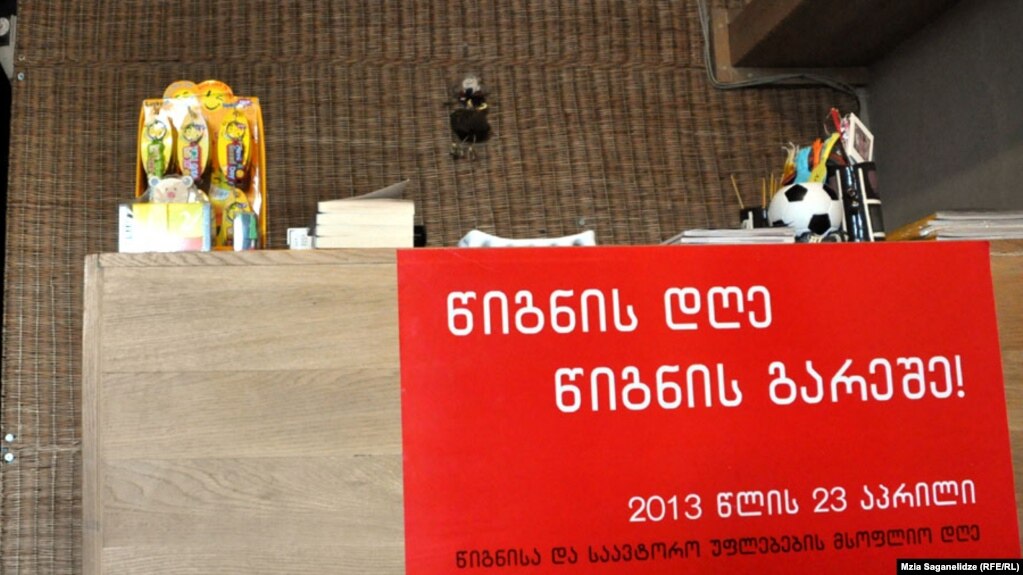
Book day – without books

2013

This AI-generated translation may not be completely accurate.
Book day – without books
On April 23, 2013, International Book Day, the traditional book fair and sale did not take place in Pushkin Square. Bookstores were closed as well. Georgian publishers and booksellers held a protest against the decision made by the Ministry of Education and Science on April 8, 2013, which stipulated that school textbooks would be printed in a few printing houses selected by the ministry and distributed to students free of charge. According to the publishers, this decision violated the copyright and property rights of textbook authors and publishers.
While much of the public welcomed the ministry’s plan to distribute free school textbooks funded by the state budget, publishers sought to explain what they described as the “populist” motives behind the government’s decision. Tamar Lebanidze, head of Diogene Publishing, stated that the Ministry of Education was attempting to use textbooks developed and refined over many years by publishing houses without their consent.
“The Ministry of Education took ready-made textbooks and handed them over to printing houses for publication, without even announcing a tender to select those printers. As a result, in terms of financial compensation, they are offering us only about 10% of the printing costs,” said Tamar Lebanidze.
Publishers also expressed their protest through an informational video that aired on television and circulated on social media.
The Minister of Education and Science, Giorgi Margvelashvili, gave a brief and direct comment regarding the April 23 protest. He said he regretted the publishers’ decision to hold the demonstration. Responding to accusations of creating a monopoly or violating intellectual property rights, Margvelashvili stated:
“In a society governed by law, the guarantee of intellectual property is a contract, and we are fully complying with every contractual obligation. Therefore, I don’t see what exactly we are violating.”
Publishers filed a formal complaint with the Prime Minister and also appealed to the Tbilisi City Court, requesting the suspension of the textbook printing process.
This 2013 protest by Georgian publishers and booksellers underscored tensions between the state’s educational policy and the publishing industry, raising public debate about intellectual property rights, government control over textbook production, and the limits of cultural and economic independence in Georgia’s education sector.