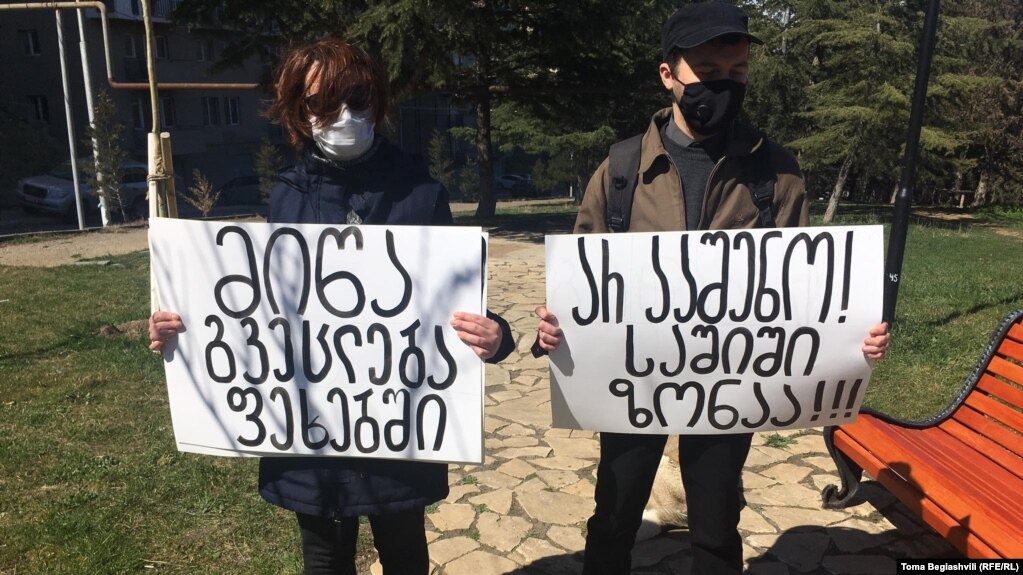
Demonstration due to the Landslide in Vashlijvari

2021

This AI-generated translation may not be completely accurate.
Demonstration due to the Landslide in Vashlijvari
On March 18, 2021, a landslide occurred in Tbilisi on the road connecting Vashlijvari and Nutsubidze — large and deep cracks appeared on the slope. The director of the Institute of Earth Sciences and the National Seismic Monitoring Center, geologist Tea Godoladze, said that a mass of soil weighing half a million cubic meters had shifted. Since 2019, Tbilisi City Hall has been constructing a new road in this area, connecting Lisi Lake to Gelovani Avenue.
On March 28, residents held a protest. “The ground is slipping beneath our feet,” “Don’t build, it’s a dangerous zone,” read the banners held by the protesters. They demanded:
- A moratorium on all types of construction in Vashlijvari due to the danger, including suspension of the issuance of evaluations on pending construction permit applications.
- The immediate creation of an independent group of Georgian and international experts (with publicly disclosed names) to fully study the Lisi ridge and its risks, with local residents participating in the working group and public discussions.
- Installation of a monitoring system on the damaged slope of Lisi, which would observe the slope 24/7 and publicly provide updates.
- Not to open Machavariani Street until its safety is confirmed by expert evaluations.
- Study and fully disclose the geological analysis of the Vashlijvari area.
Protesters called on everyone to sign a petition stating that all residents of Vashlijvari were living in extreme fear because of the dangerous landslide discovered on the Lisi ridge.
The next day, City Hall announced that reinforcement works had begun on the landslide-prone slope. Starting on April 8, cracks in the landslide zone were filled and cemented to stop the movement. Several monitoring devices were placed in the area. City Hall also brought in German expert Peter Neumann to study the process. On August 26, the road closed due to the landslide was reopened and traffic resumed.