Film Industry Protests

2023

This AI-generated translation may not be completely accurate.
Film Industry Protests
In June 2023, the Ministry of Culture launched a reorganization of the Georgian National Film Center, abolishing the positions of the deputy directors. This followed several critical Facebook posts by employees and a statement on the Film Center’s website, in which staff expressed concern over recent developments and demanded the preservation of the institution’s independence.
During the reorganization, the ministry appointed finance specialist Koba Khubunaia, who had previously worked at the Ministry of Justice, as acting director, and Bacho Odisharia, a sociologist and anchor from the pro-government propaganda outlet “POSTV,” as deputy head of the film production department.
According to the law, the National Film Center, although established by the Ministry of Culture, must operate independently. Employees believed the restructuring and personnel changes were a way to punish film professionals for expressing dissent and to bring the film industry under political control — targeting the only state body that supports film production, represents Georgia at international festivals, and promotes the sector’s interests at the national level.
On June 12, Film Center employees released a statement demanding that the reorganization be suspended until a new director was selected by a commission composed of representatives from the film sector. They argued that the ministry-appointed leadership and the restructuring process were attempts to subordinate Georgian cinema to political interests.
On June 28, representatives of the cultural sector sent a letter to two parliamentary committee chairs — Eliso Bolkvadze (Culture Committee) and Mikheil Sarjveladze (Human Rights Committee). They reminded parliament that under Minister Thea Tsulukiani’s personnel policy, “dozens of employees were illegally dismissed,” most of whom were still in court; in one case, discrimination had been confirmed by the Public Defender’s Office. The letter described the Film Center reorganization as part of the same discriminatory pattern.
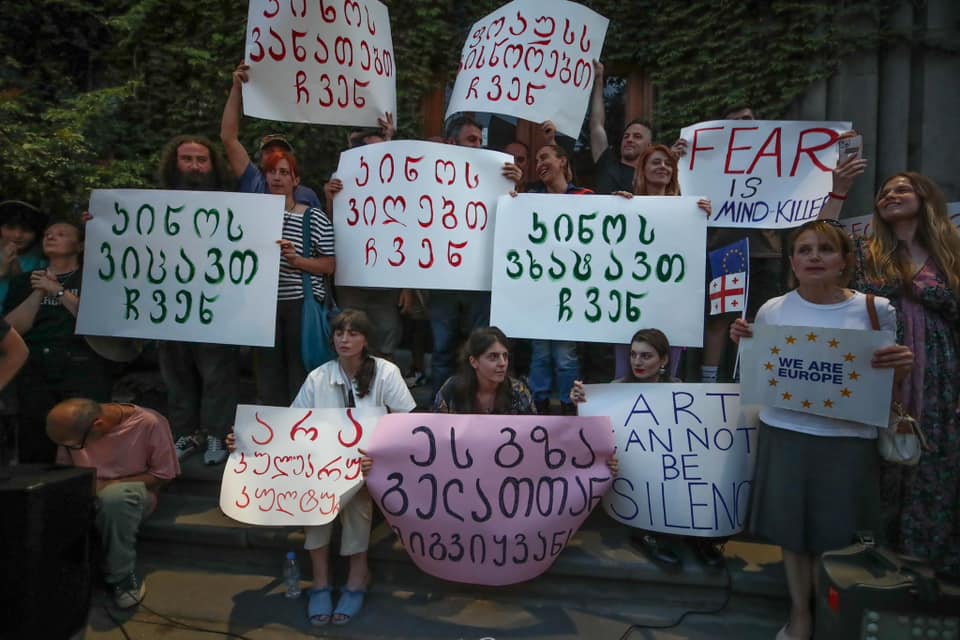
During a committee hearing, cultural workers staged a protest performance wearing T-shirts that read: “Four enemies in every three people,” “No to censorship,” “Save culture,” “Independence for culture,” “Independence for the Film Center,” “Freedom for the Museum,” “Georgian cinema is in danger.”
On July 12, film professionals held another protest outside the Ministry of Culture, demanding changes to the director appointment procedure. Their banners read: “We shoot the films,” “We light the films,” “We paint the films,” “We protect the films.”
The ministry did not clarify what the reorganization entailed, but several employees involved in the protest were dismissed by a commission that met on June 20 — without their prior knowledge.
Protesters also brought a manifesto to the ministry:
“We, the heirs of the repressed cinema of the past century,
cannot accept dictated scripts or creative boundaries.
We reject one-dimensional art;
we refuse to take part in backroom politics;
we only mock failed censors
and their attempts to tame Georgian cinema.”
Other cultural institutions affected by Tsulukiani’s policies — including the Book Center, the National Museum, and several theaters — publicly joined the Film Center’s protest. Georgian writers, translators, and publishers echoed these concerns in an open letter on June 16.
As a result, many filmmakers boycotted the National Film Center and refused its funding.
On June 12, 2024, filmmakers held another protest in front of the Film Center under the slogan “Georgian Cinema is in Danger,” denouncing censorship. Protesters held placards reading: “Fortress of Kajeti,” “Ministry of Propaganda,” “Slaves.” They marched to the fourth floor, where the Film Center’s office was located, but no one came out to meet them. Returning to the courtyard, they played satirical songs — written specifically for the protest with the help of artificial intelligence — including one titled:
“Queen of Censorship,
How well white suits you, Bacho…”
This time, the protest was sparked by the “anti-LGBT propaganda” bill that the ruling Georgian Dream party was pushing forward — which filmmakers viewed as another form of censorship. Parliament eventually passed the homophobic and anti-LGBT legislative package in October 2024.
Filmmakers who had left the National Film Center continued their advocacy for Georgian cinema through a newly established independent organization — the Georgian Film Institute.