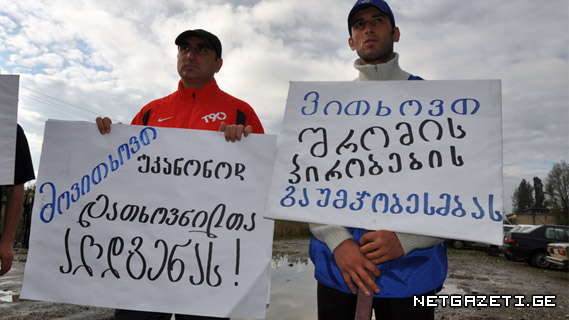
Kutaisi “Eurasian Steels” employees strike

2011

This AI-generated translation may not be completely accurate.
Kutaisi “Eurasian Steels” employees strike
On September 13, 2011, around one hundred workers at the metallurgical plant Hercules, owned by the Georgian-Indian company Eurasian Steels in Kutaisi, went on strike, with several of them beginning a hunger strike. Earlier, on September 2, the workers had held a warning strike demanding the reinstatement of employees dismissed for union activity and improvements in working conditions. According to the strikers, the company responded by firing several more workers. Union representatives stated that police dismantled the protesters’ tent and later returned it damaged. According to Interpressnews, residents living near the plant joined the protest, claiming that the factory’s pipes operated without filters, polluting the air and harming their health.
Union representatives said that the plant employed about 350 Georgian and 150 Indian workers who faced extremely harsh working conditions.
On September 15, police detained the hunger strikers and dispersed the protest. According to the trade union press office, among those detained were the four hunger strikers — Gocha Darjania, Ramaz Gogiava, Kakha Tsertsvadze, and Yuza Kakhidze. The police reportedly detained workers as they tried to flee, and according to various sources, up to 40 people were arrested in total. The vehicle in which the hunger strikers had been spending the night was also towed away.
The Ministry of Internal Affairs claimed that the plant’s administration had called the police because the strikers were inciting confrontation among workers who had refused to join the strike. The detainees were released shortly afterward but were required to sign written statements pledging not to participate in future strikes or protests and not to disrupt the factory’s operations.
On September 18, police arrested three additional workers who, according to the Georgian Trade Unions Confederation (GTUC), had been “actively cooperating with the unions in preparing legal actions regarding the dispersal of the strike.” All three were charged with disobeying police orders, reportedly after refusing to take a drug test. On September 19, the Kutaisi City Court found them guilty and sentenced them to ten days in administrative detention.
On September 22, the GTUC held a protest outside Eurasian Steels’ office in Tbilisi. On October 26, union members gathered again — this time in front of the Ministry of Economy and Sustainable Development in Tbilisi — carrying banners reading: “Hercules – the cradle of slavery!”, “Solidarity with metallurgists!”, and “Reinstate the illegally dismissed!”. Protesters stood on the ministry’s front steps demanding justice.
Another solidarity rally was held in Kutaisi on September 26, outside the temporary detention facility, joined by representatives from about 30 NGOs.
The company’s management rejected all the workers’ demands. One of the plant directors, Robert Tomaradze, called the strikers’ claims baseless.