Teachers’ Mass Strike

1996

This AI-generated translation may not be completely accurate.
Teachers’ Mass Strike
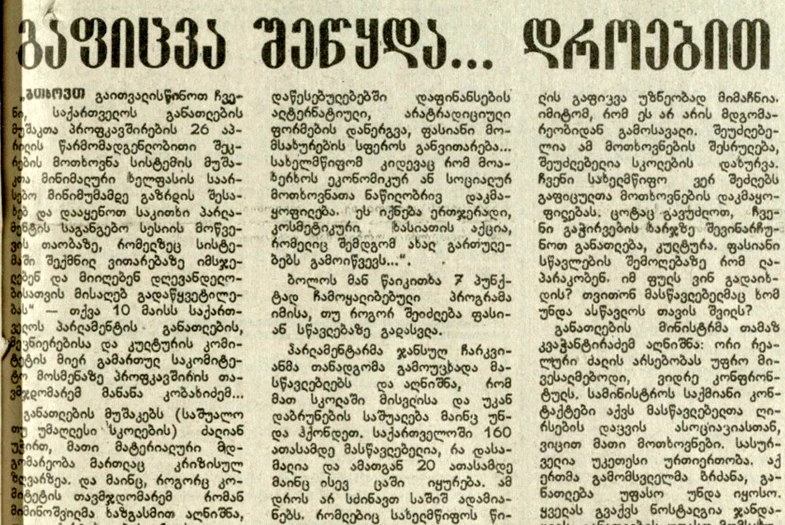
On April 26, 1996, at a meeting of the Georgian Education Workers’ Trade Union, members demanded that salaries for education system employees be raised to at least the subsistence minimum and called for an extraordinary session of parliament to address the issue. During this period, a mass teachers’ strike began across the country.
On May 10, the Parliamentary Committee on Education, Science, and Culture held a session where union leader Manana Kobakhidze presented teachers’ demands. Committee chairman Roman Miminoshvili praised the dedication of educators, noting that while factories had stopped and farmers abandoned their land, teachers never betrayed their students—an act he described as true heroism.
Reports from the press at the time indicated that by May 10 a large number of schools were on strike—some sources cited 50 schools, others around 20. On May 9, the strike committee issued another appeal to parliament and the education minister, criticizing the system’s inability to adapt to economic realities. They argued that alternative or non-traditional funding models had not been introduced, nor had paid services been developed. Even if the government managed to partially meet economic or social demands, they said, it would be only a temporary, cosmetic solution that would lead to new complications.
Kobakhidze told committee members that teachers expected an answer by May 20. “From May 25, teachers go on a 48-day break, and we cannot even provide them bread money,” she said. MP Giga Lordkipanidze condemned the strikes in schools and theaters as unethical, arguing that “this is not a way out. These demands cannot be met. We must endure a little longer and preserve education and culture at the expense of our hardship.”
Education Minister Tamaz Kvachantiradze told journalists that teachers’ salary demands were doomed to rejection. At the hearing, he repeated this stance, adding, “We are fighting by every possible means to give teachers something before they leave for vacation.” He noted that while salary increases were not possible, work would begin on expanding paid educational services.
At the end of the session, a working group composed of ministry and teachers’ union representatives was created to prepare proposals for parliament. By May 14, classes had resumed in all schools.
According to the State Department of Socio-Economic Information, in 1996 Georgia had 3,231 secondary schools, including 2,502 in rural areas. A total of 730,000 students were enrolled, taught by 80,137 teachers.