PolitikaSHE – Gender Quota Requirement

2015

This AI-generated translation may not be completely accurate.
PolitikaSHE – Gender Quota Requirement
Since 2015, organizations working on women’s rights had been calling for the introduction of mandatory gender quotas. They believed that if political parties were required to include women on their electoral lists—and more women entered parliament—women’s representation in politics would increase.
Under the slogan “More Women in Parliament,” women’s organizations marked March 8, 2015, in 25 cities across Georgia. Afterward, several versions of a draft law were prepared, but on December 3, 2015, the Parliament’s Legal Affairs Committee voted them down. In February 2016, the women’s movement launched an informational campaign, meeting with the public and explaining the importance of gender quotas. Stencils appeared across cities with the slogan “PolitikaSHE.”
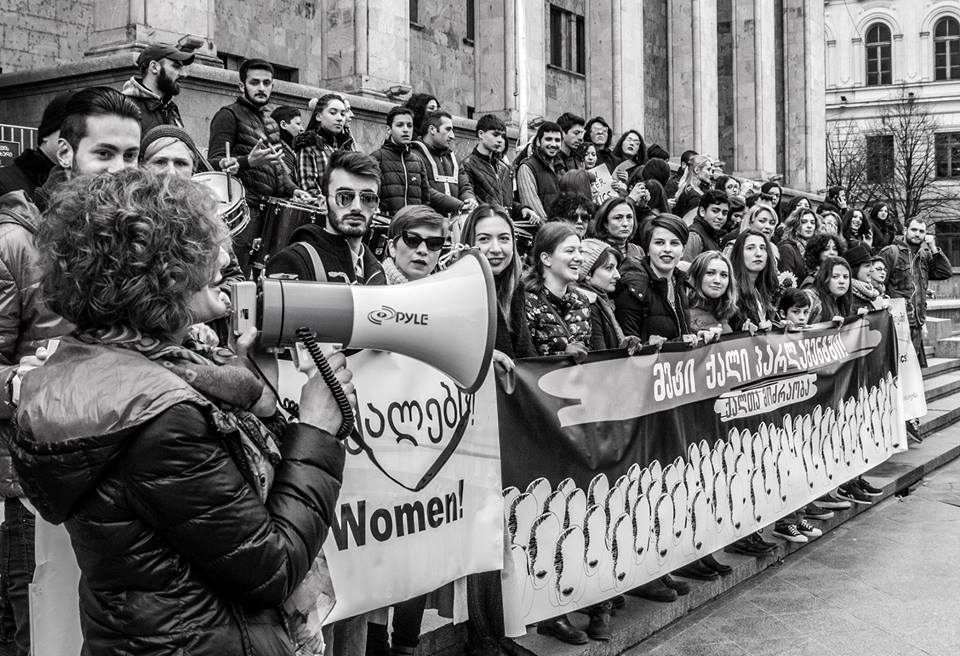
On March 8, 2016, two protest rallies were held, uniting under two slogans: “More Women in Politics” and “Protected Labor Rights.”
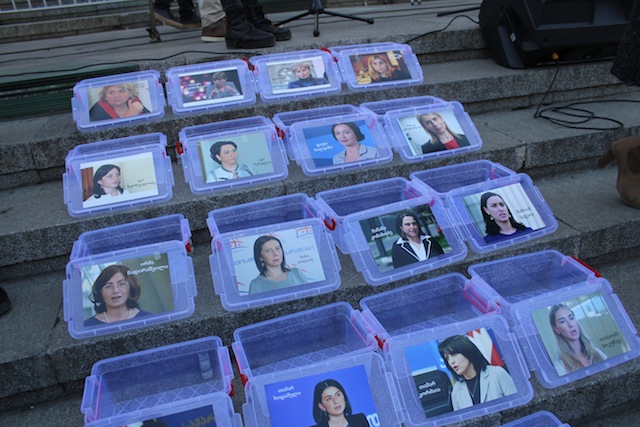
The rally organized by the Women’s Movement demanding women’s participation in politics began in front of the Parliament building. Amid chants and the sound of whistles, the women gathered in front of Parliament demanded protection of their rights. On the steps of the legislature, 150 boxes were displayed—each bearing a photo of an MP (there are 150 in total). Inside the boxes were letters written by members of the Women’s Movement and others, urging MPs to support gender quotas.
A second group gathered in front of the Conservatoire and marched toward Parliament, demanding improved labor rights for women.
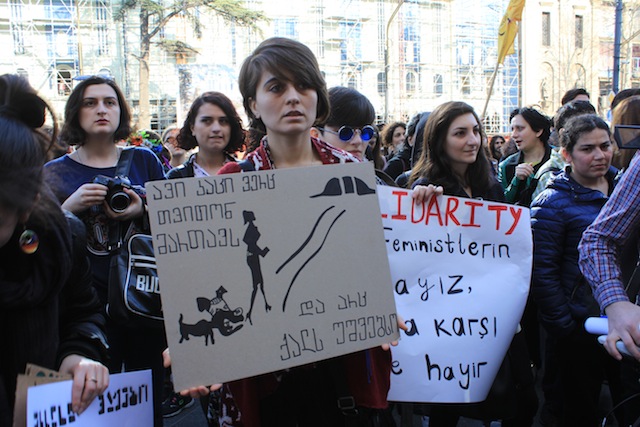
Participants in the march included: Women’s Fund in Georgia, Human Rights Education and Monitoring Center (EMC), Young Greens, Women’s Initiatives Supportive Group (WISG), Women’s Gaze, Vegan Georgia, LGBT Georgia, Anarchafeminists, and Radical Lesbian Group. Chants were heard: “What do we want? – Equality! When do we want it? – Now!”
With placards reading “I don’t need flowers, I need rights,” “Paid parental leave for all parents,” and “Women’s labor is invisible,” they marched toward the Parliament building, where they joined the rally organized by the Women’s Movement.
Those gathered outside Parliament sent letters to all MPs, urging them to support the draft law on gender quotas.
In 2017, a Task Force composed of NGOs and international organizations began collecting signatures for a legislative initiative. After a month and a half, the initiative—signed by more than 37,000 people—was submitted to Parliament on June 12. Like many subsequent proposals for legislative amendments, it was rejected. Activists continued to keep the issue on the agenda through various forms of protest and advocacy.
Parliamentary discussions on the topic continued, and on June 2, 2020, the Parliament of Georgia finally adopted gender quotas. According to the amendments to the Election Code, political parties were required to include at least one candidate of a different gender in every group of four on their proportional party lists. Gender quotas were introduced as a temporary measure, to remain in force until the 2032 elections. However, in 2024, the ruling Georgian Dream party supported an initiative by the Girchi party and abolished the quotas.