Protest in Mushevan

2022

This AI-generated translation may not be completely accurate.
Protest in Mushevan
In Bolnisi Municipality, two companies producing non-ferrous metals operated: RMG Copper and RMG Gold. In 2022, RMG Copper sought to expand its operations to the Mushevani-2 gold-copper deposit, a 11.27-hectare area, where it planned to extract minerals through open-pit mining using drilling and blasting methods.
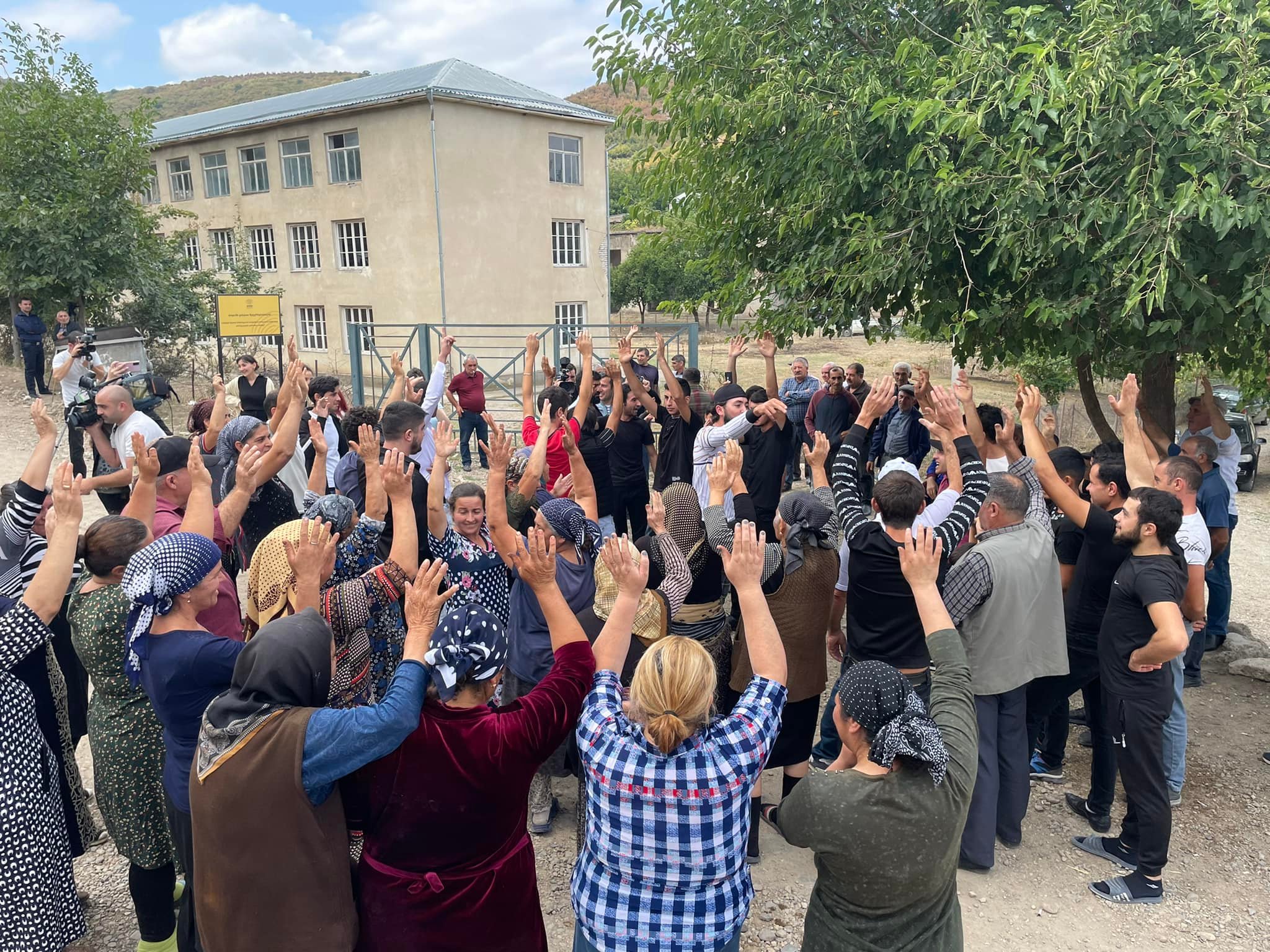
On July 28, 2022, residents of Mushevani village gathered in the village center to protest the project. Locals told Radio Marneuli that most residents had not been informed about it at all. One villager, Alikhan Yakhiaoglu, said: “They deceived people by promising gas and water for the village and collected signatures that way. People didn’t know what they were signing. When dynamite explodes, it can damage our homes and scare people. What are we supposed to do? They’ve been cutting down trees around us for years; the air has changed. Trees are life — we breathe through them.”
That same day, with support from the Salam Platform, a local initiative group from Mushevani collected signatures and sent a collective appeal to the National Environment Agency, asking it to stop the project. The Social Justice Center took up legal representation for the group.
On September 13, 2022, some residents of Mushevani planned another gathering and protest petition against RMG Gold’s planned open-pit mining near the village. However, when they arrived, they were met by fellow villagers who said they would not allow the protest to take place.
According to Radio Marneuli, those opposing the protest claimed that RMG had promised to provide water and gas to the village and to renovate the local school, which was why they supported the company’s project.
The rest of the residents disagreed, addressing a petition to Parliament, the Prime Minister, and the President:
“We oppose RMG Copper’s gold-copper mining in our village and ask that the authorities consider the local population’s position when making their decision,” the petition read.
Locals said the planned mining site was only 808 meters from the village, with roads for heavy machinery located 600–800 meters away. They feared that frequent explosions — reportedly several times a week — would damage their homes. They also warned that RMG planned to dig a new open pit near the settlement once permits were granted.
According to Kamran Mammadli of the Social Justice Center, the issue was decided “democratically” — villagers raised their hands to vote against allowing RMG Gold to begin operations.
RMG, in response, claimed that most residents supported the project and that it had signed a community development memorandum with them. The company asserted that the mining site was far from the village and would have “no ecological impact,” citing preliminary studies and claiming that the majority of residents were aware of this.
On November 1, 2022, the National Environment Agency granted RMG Gold an official permit to mine gold and copper.
On November 11, part of the Mushevani community gathered in the village ritual hall to protest the permit. They held signs reading: “Protect Mushevani Village” and “Protect the Law, Protect the People.”
The Social Justice Center stated that the permit was issued illegally and announced plans to challenge it in court, arguing that locals had not been properly included in the process and that the agency had ignored environmental and legal concerns submitted by the organization and an independent expert.
A few months earlier, on May 16, 2022, Radio Free Europe/Radio Liberty had published an investigation revealing that RMG controlled a vast area spanning Bolnisi, Dmanisi, and Tetritskaro municipalities — roughly 2% of Georgia’s territory — under licenses valid until 2041.
RMG Group mined gold and other precious metals, earning a combined revenue of 2.4 billion GEL between 2017 and 2020, with profits exceeding 650 million GEL. The company was owned by Russian billionaires Dmitry Troitsky and Dmitry Korzhev through the real estate holding Capital Group. Both had previously shared ownership of Bank Saint Petersburg with Vladimir Putin. Some RMG employees were among the largest donors to the ruling Georgian Dream Party, contributing around 1.35 million GEL in recent years.
RMG extracted ore both through open-pit mining and underground tunnels. Both methods involved drilling and explosions across thousands of square meters, releasing harmful substances into the air and contaminating soil and rivers through rain and runoff.
For years, mining had polluted rivers and soil in villages across Bolnisi and Dmanisi with heavy metals. In 2018, scientists studying Balichi village near RMG’s Sakdrisi mine found that lead levels in the soil exceeded safe limits by up to 300%.
The same investigation revealed that residents who had once protested RMG’s operations later fell silent because they or their relatives had been employed by the company. “Everyone is quiet now — if you speak out, they’ll retaliate. Every family has at least one person working at RMG, including my son. The village is satisfied,” one resident told Radio Free Europe.
In both Bolnisi and Dmanisi, many households had at least one member employed by RMG Group — especially in Balichi village, located near the mining hub of Kazreti.
Over the past decade, RMG had repeatedly committed similar environmental and regulatory violations, facing only minimal fines and drawn-out court proceedings.
In Mushevani as well, the protests that continued through November 2022 eventually ended without any tangible result.