Protest Over Power Outage

1996

This AI-generated translation may not be completely accurate.
Protest Over Power Outage
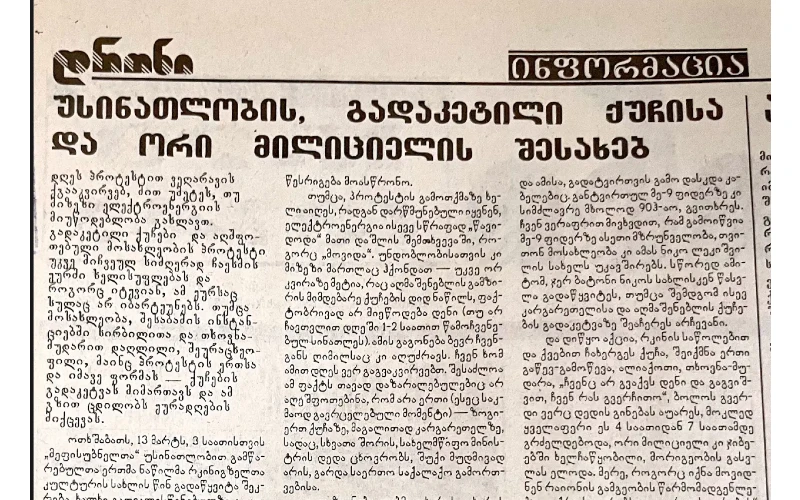
On March 13, 1996, residents of the Mefisubani district in Tbilisi, frustrated by electricity shortages, gathered in front of the Railway Workers’ House of Culture (today the Vaso Abashidze New Theatre). According to the newspaper Droni, fewer people joined the protest than expected, because once authorities learned that residents were preparing to rally, power was switched on. Women, long deprived of electricity, could not resist the chance to wash clothes and iron, abandoning plans to take to the streets. Those who still protested believed that if they dispersed, the power would be cut again just as quickly as it had been restored.
Droni reported that the streets around Agmashenebeli Avenue had been without electricity for nearly two weeks, while Kargareteli Street—where the mother of the State Minister lived—did not face the same problem. The article noted that residents connected to the 13th feeder line, including most protesters, had been switched to another supply, increasing consumption. As a result, the limited electricity quota lasted only one or two hours a day, and “cables burst under the overload.”
Protesters blocked Agmashenebeli Avenue with iron beds and stones, causing unrest that lasted about three hours. Passersby demanded the road be reopened, telling demonstrators: “Why target us? We don’t have electricity either.” Local district officials arrived on the scene, promising the protesters “golden hills and a better life.” After these assurances, the crowd dispersed peacefully, Droni reported.