Rally Demanding Shevardnadze Not to Resign

1993

This AI-generated translation may not be completely accurate.
Rally Demanding Shevardnadze Not to Resign
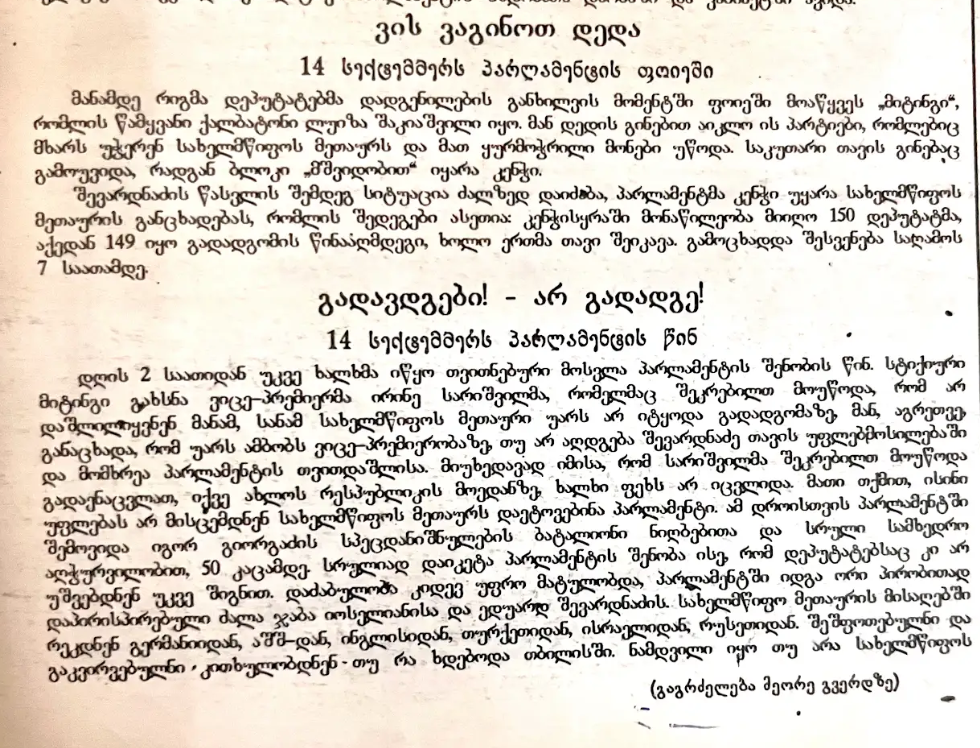
On September 14, 1993, during a session of parliament, Jaba Ioseliani, then a member of parliament, called the course taken by Eduard Shevardnadze, Chairman of Parliament and Head of State, “communist” and “totalitarian.” In response, Shevardnadze declared:
“Yes, years ago, I began the fight for universal order in a different way. But when I saw clearly that the culprit was not any single individual, but the entire system itself—rotten, doomed to collapse—I did everything in my power to destroy it. Let the future and God judge who did more to bring down the concept of ‘communism’—myself, or those who now accuse me of every possible crime… Eduard Shevardnadze has resigned.”
This statement caused great turmoil both in parliament and in society at large. Members of parliament voted on the matter, and out of 150 deputies, 149 voted against his resignation, while one abstained.
Meanwhile, thousands of people gathered outside the parliament building, demanding Shevardnadze’s return to office and the implementation of a much stricter domestic policy. The newspaper Sakartvelos Respublika quoted one demonstrator:
“Mourners came in tears, mothers who had lost their sons in Abkhazia—we are counting the days and hours until the peacekeeping mission arrives, so that we may at least find the graves of our boys fallen in Gagra and Ganmukhuri. We had placed our hopes in Shevardnadze, and now?… He has no right to abandon us in such hardship. It is difficult to endure all that he has suffered at the hands of villains, but for the sake of our sons’ memory, he must go on.”
Deputy Prime Minister Irina Sarishvili urged the crowd not to disperse until Shevardnadze withdrew his resignation. At the same time, a special forces battalion under Igor Giorgadze, Deputy Minister of Internal Affairs, entered parliament wearing masks and sealed the building, not allowing even deputies inside. Outside, the rally continued, led by Giorgi Maisuradze, a doctoral candidate at Saarbrücken University. Professors entered parliament as well, demanding a meeting with Shevardnadze.
Shevardnadze eventually appeared before the demonstrators, thanked them, and announced that he would return to his post on two conditions: 1. The parliament adopts a decree on the introduction of extraordinary measures. 2. The parliament leaves him as Chairman (Head of State) and declares a three-month recess.
He argued that adopting extraordinary measures would create better conditions for the fight “against murderers and the criminal underworld.”
Catholicos-Patriarch Ilia II also addressed the crowd, calling on Shevardnadze to remain in office: “I have seen many bitter days. If resignation were the solution, I would be the first to resign,” he said.
Following the rally, parliament convened and approved Shevardnadze’s demands. It endorsed the introduction of extraordinary measures from September 20, 1993, for two months, amending the law “On the Introduction of Extraordinary Measures” to grant the Head of State the authority to declare and extend a state of emergency.
By Shevardnadze’s decree:
- Wearing military uniforms and carrying firearms without authorization was banned.
- The Prosecutor’s Office, Ministry of Internal Affairs, and Ministry of Defense were tasked with disarming armed gangs, prosecuting their members, and recapturing escaped prisoners.
- Demonstrations and other types of rallies were prohibited.
- Authorities were instructed to monitor compliance with the Law on the Press and Mass Media.
- A special regime for entering and leaving settlements was imposed, and raids were ordered.
Parliament also met Shevardnadze’s second demand, suspending plenary sessions until the state of emergency ended. Members of parliament continued their work in commissions instead.