Strike of Public Transport Workers and Tbilisi Police

1994

This AI-generated translation may not be completely accurate.
Strike of Public Transport Workers and Tbilisi Police
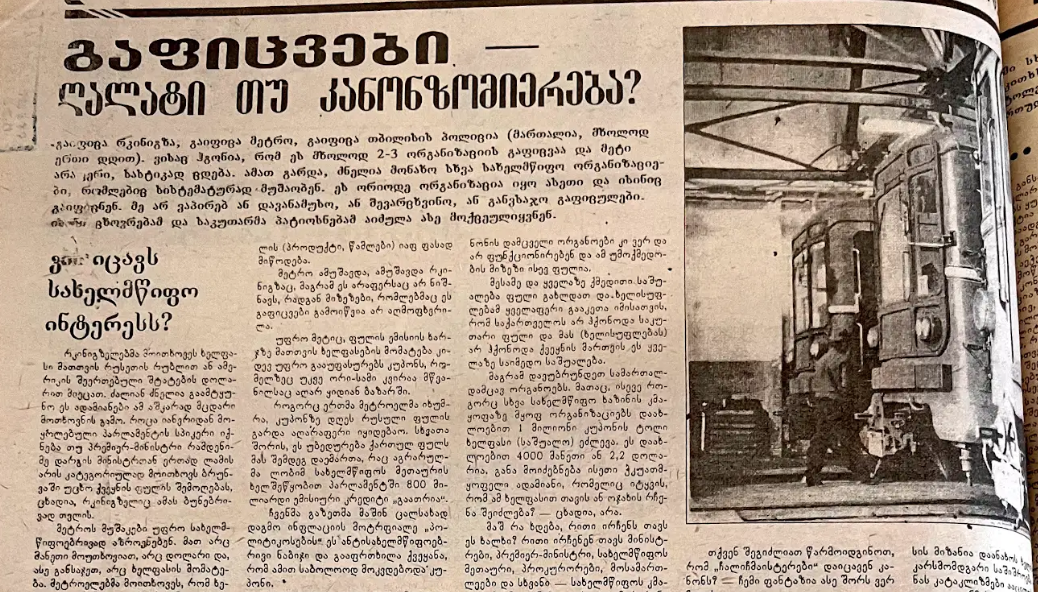
On March 30, 1994, workers from the Georgian railway, Tbilisi metro, and the police (for one day) went on strike. Railway workers demanded that their salaries be paid either in rubles or US dollars, valuing one hour of work at 1,500 rubles or one dollar. At the time, Georgia’s national currency was the coupon, which had drastically devalued.
The metro drivers did not demand rubles or dollars. Instead, they called on the government to ensure the “stability of the national currency” and stabilize prices, which would allow them to support their families.
Authorities offered metro workers a wage increase and cheaper access to essential goods such as food and medicine. Following this, both the metro and railway resumed operations. However, as the newspaper Droni noted, these promises “meant nothing, since the causes of the strike were not resolved. On the contrary, wage increases funded by money emission would further devalue the coupon, which had already lost all credibility—so much so that for two or three weeks it could not even be used to buy greens in the market. This disaster struck Georgian currency after the agrarian lobby, with the support of the Head of State, pushed through parliament an 800 billion emission credit. The coupon is dead, and this has brought the country to the brink of social explosion.”
The newspaper also pointed out that salaries for law enforcement employees were equivalent to just $2.20 per month, an amount impossible to live on: “So what is happening? How do these people survive? How do ministers, the prime minister, the head of state, prosecutors, judges, and other officials—those on state salaries—support themselves? Clearly, by other means. In the Militsia (police) it is simple: arrest a thief and extort money to release him. Others make deals in different ways. Can you imagine that such ‘deal-masters’ will uphold the law? In such a society, dreaming of justice is meaningless. A state cannot be built on lies, and where lies are the foundation, the law cannot prevail,” Droni wrote.