Protesting the Results of the 2020 Elections

2020

This AI-generated translation may not be completely accurate.
Protesting the Results of the 2020 Elections
On October 31, 2020, parliamentary elections were held in Tbilisi with a 1% threshold. The CEC began announcing preliminary results late at night. According to the official data, with 48.22% of the vote, “Georgian Dream” remained in power for a third term. In total, the parliamentary majority received 90 mandates, while the opposition obtained 60. That year, the elections were held under a mixed system (120 proportional, 30 majoritarian), and in all 30 majoritarian districts, the candidates of “Georgian Dream” won.
Eight more parties passed the 1% threshold: the “United National Movement” (“Strength in Unity”), “European Georgia,” “Lelo,” “Strategy Aghmashenebeli,” “Alliance of Patriots,” “Girchi,” “Citizens,” and the “Labor Party.”
The majority of opposition parties participating in the elections called the results falsified and refused to enter parliament.
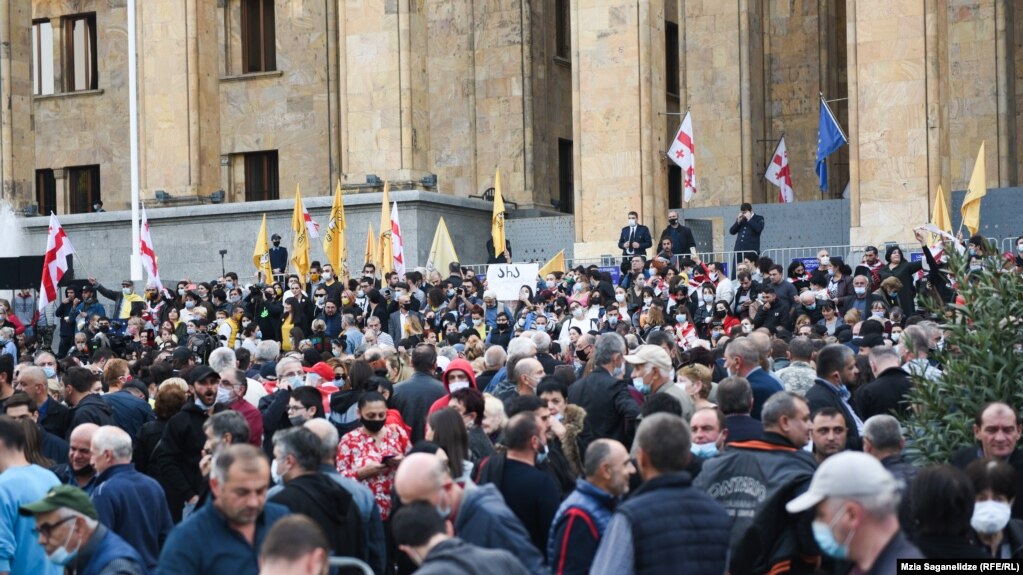
On November 1, opposition parties met at the office of the “Labor Party” to analyze the election results. The first protest against the “stolen elections” was held on November 1 in front of the parliament building. After speeches, protesters marched toward the residence of Bidzina Ivanishvili, founder of “Georgian Dream.”
Protests continued in the following days in front of the parliament and the CEC in Tbilisi, as well as in other major cities — Zugdidi, Batumi, and Kutaisi. Marches also took place.
Another protest was held on November 8 near parliament — the opposition gave the government until 20:00 to dismiss the CEC chair. When the demand was not met, protesters moved to the CEC building, where the area had been fenced off with temporary metal barriers. The CEC claimed that it was an independent body and that pressure was being exerted on it.
To disperse the protesters, police used water cannons and tear gas. One protester suffered an eye injury. The Ministry of Internal Affairs stated that the water cannon was used due to “urgent necessity.” 19 people were detained that day.
Government officials, including Prime Minister Giorgi Gakharia and “Georgian Dream” Secretary General Kakha Kaladze, said they were ready for dialogue.
On November 18, a silent protest was held on Rustaveli Avenue in Tbilisi, organized by opposition parties, with the main slogan: “It’s falsified.” The protest chain was intentionally timed to coincide with the visit of U.S. Secretary of State Mike Pompeo to Georgia. Citizens formed a live chain stretching from the Philharmonic Hall to the parliament building, holding stickers resembling CEC protocols with the inscription “Falsified,” along with Georgian and U.S. flags. They stood on stickers laid on the pavement that displayed images of Bidzina Ivanishvili and Vladimir Putin.
The elections took place during the COVID-19 pandemic, and restrictions imposed by the Georgian government remained in effect during the protests. On December 1, some protesters spent the night in tents set up in front of parliament. The Public Defender stated that despite the restrictions, the right to assembly and manifestation was not prohibited.
The new parliament convened on December 11. Protests continued in the following days, including during the government’s approval. On December 4, tents were set up in Telavi and people remained there overnight. “Election fraud is punishable by law”; “Georgia is occupied by a Russian oligarch” — these were written on the tents.
On January 4, they organized a car march in Gurjaani, Kvareli, and Telavi. Civil activist and tent protest participant Ramaz Aivazashvili said that on January 1, a car crashed into one of the tents and those inside survived by chance. The results of the investigation into the incident remained unknown.
On March 20, the opposition announced that a large, continuous protest would begin on May 15.
Partner countries of Georgia became involved in negotiations between the opposition and the government. After lengthy communication, with the direct involvement of President of the European Council Charles Michel, an agreement titled “A Way Ahead for Georgia” was signed on April 10, 2021, commonly referred to as the “Charles Michel Agreement.” The signatories agreed on five issues:
- Respond to issues perceived as politically motivated justice (meaning amnesty for detainees related to the “Gavrilov Night” case);
- Ambitious electoral reform — the 2024 elections would be fully proportional with a 2% threshold; the CEC chair and the professional CEC members would be elected with 2/3 parliamentary support.
- Rule of law / judicial reform: increase transparency in judicial appointments at city and appeals courts; consider the Venice Commission conclusion regarding Supreme Court appointments; reform the High Council of Justice and change the procedure for appointing the Prosecutor General;
- Power sharing in parliament — the opposition would chair two out of five key committees;
- Future elections: if “Georgian Dream” received less than 43% in the 2021 local elections, snap parliamentary elections would be held in 2022 under a fully proportional system.
The agreement was signed by: “Georgian Dream,” “Lelo,” “Republicans,” “Strategy Aghmashenebeli,” “Girchi,” “Citizens,” and several independent MPs. Among the parties that crossed the electoral threshold, the signatories did not include the “United National Movement,” “European Georgia,” and the “Alliance of Patriots.”
Before the agreement was signed, only two opposition groups had entered parliament: MPs from the “Alliance of Patriots” list, “European Socialists,” and “Citizens.” After the agreement, the representatives of other parties — except “European Georgia” — agreed to take up their mandates. Four independent MPs entered parliament: Davit Bakradze, Shalva Shavgulidze, Armaz Akhvlediani, and Tariel Nakidze, who had won mandates as members of “European Georgia,” but since they opposed the party’s boycott decision, they left the party and then entered parliament.
Two months after the agreement, CEC chair Tamar Zhvania resigned.
On July 28, 2021, “Georgian Dream” announced that it was withdrawing from the agreement, arguing that the main goal — reducing polarization and radicalization — could not be achieved because the “United National Movement” had not signed it. According to party chairman Irakli Kobakhidze, polarization would not decrease or end if the UNM did not sign.
On September 2, one month before the local elections, the “United National Movement” signed the “Charles Michel Agreement,” arguing that the signature demonstrated readiness and confidence that the opposition would win the October 2 elections. The elections were considered a referendum because under the agreement, if “Georgian Dream” received less than 43% of the proportional votes, snap parliamentary elections would be held in 2022. However, “Georgian Dream” had repeatedly stated that no snap election would be called.
In the end, in the local elections, “Georgian Dream” won everywhere except in four municipalities. The parliamentary elections were held on schedule in 2024.