The fight against the “judicial clan”

2019

This AI-generated translation may not be completely accurate.
The fight against the “judicial clan”
On December 16, 2018, following the inauguration of Georgia’s new president, Salome Zurabishvili, a new version of the Georgian Constitution entered into force, changing the rules for composing the Supreme Court. This was a pivotal reform that could have revitalized the judiciary; instead, the most influential group within the courts grew even stronger.
The changes covered three key areas:
- The number of justices increased—rather than 11, the Supreme Court would now have no fewer than 28 judges.
- Candidates for the bench would now be submitted to Parliament by the High Council of Justice, a function previously performed by the President.
- Supreme Court justices would be appointed for life (until the retirement age) rather than for a 10-year term.
Even before these constitutional changes, the High Council of Justice exercised full control over the judiciary—among other powers, it appointed and dismissed judges.
Civil society had hope for impartiality and principle from only a few of the Council’s 15 members. NGOs periodically appealed to the President and Parliament to recognize the gravity of the situation in the courts, arguing that a “clan” of judges essentially ran the branch. After Supreme Court Chair Nino Gvenetadze stepped down for health reasons, civil society also demanded a timely nomination of a suitable replacement—someone capable of taking principled steps to clean up the system. President Salome Zurabishvili did not submit a nominee within her term. Thus, by December 2018, when the constitutional changes took effect, the High Council of Justice was left with 14 members instead of 15.
They were:
- Eight judge members elected by the Judges’ Conference: Giorgi Mikautadze, Dimitri Gvritishvili, Irakli Shengelia, Vasil Mshvenieradze, Revaz Nadaraya, Sergo Metopishvili, Tamar Oniani, Irakli Bondarenko;
- Five members elected by Parliament: Nazi Janezashvili, Irma Gelashvili, Levan Gzirishvili, Zaza Kharebava, Shota Qadagidze;
- One member appointed by the President: Ana Dolidze.
The first list
Against this backdrop, on December 24, 2018, at a meeting of the High Council of Justice, Council Secretary and judge Giorgi Mikautadze unexpectedly presented a list of ten candidates for the Supreme Court.
For that segment of civil society closely following the entry into force of the constitutional reform, it remained unclear by what criteria the Council selected these ten, especially because the list included judges who had been publicly and substantively criticized. For example, among those nominated for lifetime appointment were Mikheil Chinchaladze and two sitting Council members—Dimitri Gvritishvili and Giorgi Mikautadze (who had, in effect, nominated himself). Council non-judge member Nazi Janezashvili and many NGOs referred to these nominees as members of the “Chinchaladze clan.”
NGOs, critical non-judge Council members, the Public Defender, and other professional groups sharply criticized the process. On December 27, the Coalition for an Independent and Transparent Judiciary—uniting 40 NGOs—called on Parliament to refuse to consider the candidates altogether and instead adopt legislative changes consistent with the Constitution and international practice.
Differences within the ruling “Georgian Dream” party also became evident on December 27, when Eka Beselia, then chair of Parliament’s Legal Affairs Committee, announced her resignation. She explained that stepping down halted the committee’s consideration of the Supreme Court list.
That same day, another controversial event occurred: the High Council of Justice appointed the widely criticized judge Levan Murusidze as a lifetime judge to the Administrative Chamber of the Tbilisi Court of Appeals.
“To save justice”
A month later, on January 21, 2019, representatives of various NGOs, lawyers, politicians, non-judge Council members, and former judges gathered outside the High Council of Justice “to save justice.”
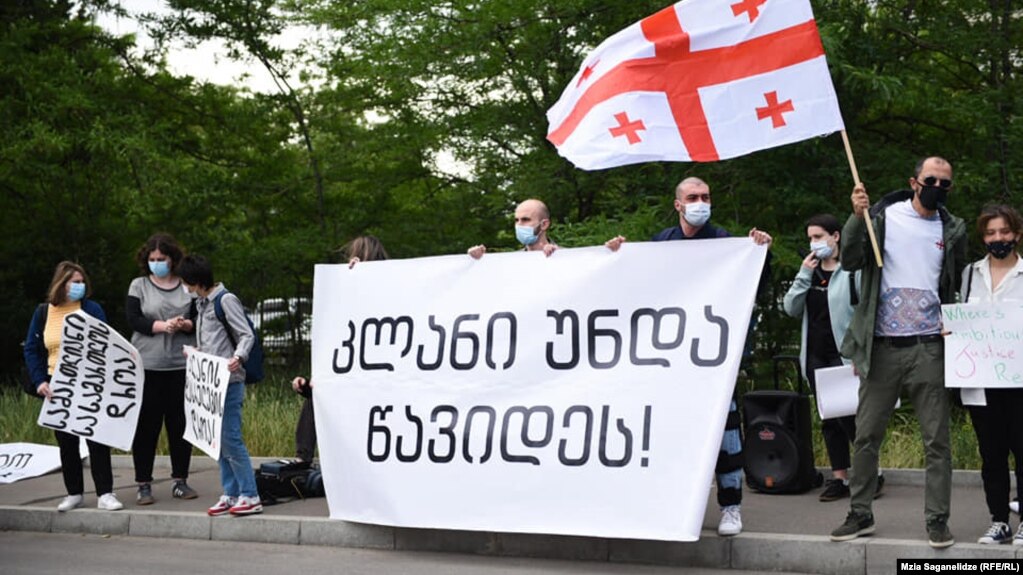
Protesters held banners reading: “Free the courts,” “The people are insulted—disband,” “Justice must be saved,” “Chinchaladze for life = injustice for life,” “End clan rule.” The fight against the “judicial clan” entered a new phase.
They read a manifesto describing the situation:
“After 2004 the courts escaped systemic corruption but came under total control of the executive. The system became an unjust one based on obedience.
After the 2012 change of government, the judiciary had a chance to restore its independence and implement true self-governance and political neutrality, thus regaining public trust. However, due to the lack of real political will to free the courts, and given piecemeal and misguided reforms, judicial independence was not achieved.
Within the judiciary, power was seized by the same group—the ‘clan’—through which the previous authorities [the United National Movement] had totally controlled the courts. Since 2012, this group has secured every judicial seat on the High Council of Justice and occupied all key administrative posts in the system.
…In recent years the clan has systematically violated or disingenuously interpreted the law and exploited legislative gaps. It is impossible to overturn clan decisions by legal means because they themselves control the system. Thus, there is no hope that, under the clan, even the best laws could cleanse the judiciary.”
They therefore demanded:
“Immediate resignation from the bench of all judge members of the High Council of Justice, and resignation of all parliamentary appointees who supported submitting the Supreme Court list to Parliament in December 2018;
Immediate resignation from the bench of clan leader and Tbilisi Court of Appeals Chair Mikheil Chinchaladze and of the symbol of servile judging, Levan Murusidze;
With broad civil society and opposition participation—and constitutional changes if necessary—Parliament must establish rules, procedures, and criteria to ensure selection of the best candidates for judgeships;
Selection and nomination of Supreme Court candidates must occur only after renewing the Council’s composition and adopting sound procedures and criteria.”
That same day, the Supreme Court nominees appealed to Parliament not to consider their candidacies “to avoid unhealthy speculation.” Signatories included: Mariam Tsiskadze, Nino Kadagidze, Mikheil Chinchaladze, Paata Silagadze, Dimitri Gvritishvili, Merab Gabinashvili, Nino Sandodze, Tamar Alania, Giorgi Tqvadze, and Giorgi Mikautadze.
NGOs viewed this as a retreat under pressure from protest. Yet the reality remained bleak—the “Murusidze-Chinchaladze clan” still dominated the courts.
Against the clan
Independent media were simultaneously preparing investigative pieces on “clan” judges. According to Studio Monitor’s investigation, Chinchaladze—Council member from 2007–2015—was the most influential figure in the judiciary. Since 2017 he had been appointed to the bench for life. In 2018 all eight judge members of the Council were linked to him through professional or family ties. Remarkably, he had not heard a single case from 2010 to 2013 but received 448,020 GEL in pay. Levan Murusidze, meanwhile, was associated with the most notorious UNM-era cases—those of Sandro Girgvliani and Sulkhan Molashvili—and had served as Council Secretary from 2013 to 2017.
On January 27, 2019, another protest was held at the Radisson hotel, where a working group was meeting on judge selection. Participants included members of the ruling majority, the Legal Affairs Committee, and the High Council of Justice. In protest, non-judge members Ana Dolidze and Nazi Janezashvili left the session.
A small group of NGO representatives and lawyers gathered outside with signs: “Courts without Murusidze,” “Courts without Chinchaladze.”
That night, intimate footage of Eka Beselia—who had actively opposed confirmation of the Council’s slate—was leaked online. She viewed it as personal retaliation.
On February 4, satirical posters were pasted on the Council’s building showing Levan Murusidze holding the severed head of Lady Justice while Georgian Dream chair Bidzina Ivanishvili checked her pulse. The Council then announced cancellation of its scheduled session.
“Lawyers are part of justice. Make your choice! Demand recusal!”—with that message, attorney Gigi Sisvadze launched a new campaign on February 26, 2019, urging lawyers to seek the recusal of Murusidze and other “clan-linked” judges from hearings they presided over.
Confrontation in Parliament
The issue escalated within Georgian Dream. Eka Beselia, Levan Gogichaishvili, and Gedevan Popkhadze left the party; later Beka Natsvlishvili also departed. Georgian Dream lost its constitutional majority.
Between March 6–11, separate bills on Supreme Court selection were registered by Beselia, by Irakli Kobakhidze, and by European Georgia. Non-judge Council members Ana Dolidze and Nazi Janezashvili also submitted legislative proposals; non-judge member Irma Gelashvili sent her views to the working group.
Despite criticism from NGOs and the opposition, on March 20 Parliament passed, 89–31 at first reading, Georgian Dream’s amendments to the Law on Common Courts without awaiting Venice Commission recommendations.
The first reading followed days of heated committee hearings. NGO representatives attended wearing “The clan must go” T-shirts.
On April 25, as the bill was considered at third reading, lawyers, human rights defenders, and civic groups held a protest outside Parliament with signs: “The clan won’t be whitewashed—you’ll be blackened,” “End clan rule,” “Save justice.” Eka Beselia left a meeting with the Ombudsman’s Office, the Bar Association, and NGOs to join the protest, saying, “When everyone tells you it’s bad, you shouldn’t insist you passed an unprecedentedly good bill.”
On May 1 Parliament adopted the bill at third reading, incorporating few Venice Commission recommendations. On May 3 EU Ambassador Carl Hartzell called the rushed process a “missed opportunity.”
After the new law, on May 10, 2019, the High Council of Justice launched the process to select Supreme Court nominees for Parliament—a nearly four-month process ending September 4.
“I want to trust the courts”
Candidates had to be interviewed first by the Council (to be shortlisted) and then by Parliament. Both stages were public. The Coalition also covered the process extensively on a Facebook page called “I Want to Trust the Courts,” highlighting who deserved a seat. The fight against the “judicial clan” moved into the digital arena.
After the Council interviews, many candidates esteemed by NGOs did not make the 20-person shortlist. Conversely, several controversial figures did—such as sitting Prosecutor General Shalva Tadumadze and his deputy Mamuka Vasadze. Questions around Tadumadze intensified when documents showed he purportedly studied at the N. Dumbadze Humanitarian Institute from 1993–1998, while registry records indicated the institute was first established in 1994. This did not block his inclusion. Tadumadze had previously been Bidzina Ivanishvili’s lawyer.
Parliament began interviews on September 23, 2019, with civil society also questioning candidates.
On September 25, PACE co-rapporteurs said Parliament had a unique chance to remedy flaws in the selection.
On September 26, during the interview with candidate Miranda Eremadze, MPs clashed. Eka Beselia slapped MP Vano Zardiashvili, later alleging he was involved in leaking her intimate video. Beselia also said Ivanishvili personally asked her in December 2018 to allow at least five of the ten Council nominees to go forward, including Chinchaladze (Chinchaladze was Zardiashvili’s best man).
On December 3, non-judge Council member Ana Dolidze and allies staged a “Drop the List” performance outside Parliament, presenting eleven reasons to reject the slate.
Selecting the judges
On December 12, 2019, the next step unfolded: before reaching a plenary vote, the Legal Affairs Committee had to approve candidates. “The process was marred by serious violations. Several MPs demanded to speak and assess candidates, but the chair refused. During a break, journalists were forcibly removed from the room without cause,” wrote Transparency International. The Committee endorsed 14 candidates. There were 20 vacancies in total; the Supreme Court comprises 28 judges.
A plenary was scheduled for the same day. It was soon interrupted when an unknown substance was released in the chamber. Later it emerged that members of the civic movement “In Service of the Country” had released a solution in protest. Parliament said five people were injured; organizers said the solution (ASD-2F) was harmless. A criminal probe was opened for “intentional serious bodily harm.”
Hours later the plenary resumed, and Parliament confirmed exactly those 14 candidates recommended by the Committee, granting them lifetime appointments. Six came from the Tbilisi Court of Appeals, chaired by Mikheil Chinchaladze.
Those appointed for life by Parliament were:
- Shalva Tadumadze—Prosecutor General (on December 30, 2024, after the dispersal of pro-European protests that injured dozens, he left the Supreme Court, where he headed the Criminal Chamber, to become Deputy Minister of Internal Affairs);
- Mamuka Vasadze—First Deputy Prosecutor General;
- Giorgi Mikautadze—Council Secretary;
- Merab Gabinashvili—Tbilisi Court of Appeals judge;
- Miranda Eremadze—Tbilisi Court of Appeals judge;
- Tamar Zambakhidze—Tbilisi Court of Appeals judge;
- Vladimir Kakabadze—Tbilisi Court of Appeals judge;
- Levan Mikaberidze—Tbilisi Court of Appeals judge;
- Nino Kadagidze—Tbilisi Court of Appeals judge;
- Nugzar Skhirtladze—Supreme Court judge;
- Maia Vachadze—Supreme Court judge;
- Lali Papiashvili—former Constitutional Court judge;
- Ketevan Tsintsadze—Independent Inspector;
- Aleksandre Tsuladze—attorney.
*Positions listed as of nomination.
Tbilisi City Court judges Lasha Kochiashvili and Gocha Jeiranashvili failed to secure enough votes, but both later joined the Supreme Court anyway—Kochiashvili in 2021 and Jeiranashvili in 2024.
Also not selected in 2019 were Tbilisi Court of Appeals judges Tamar Alania, Paata Silagadze, and Shota Getsadze—former Council members. They did not exit the system: in 2021 Silagadze was again elected to the Council; in 2023 Getsadze became Georgia’s envoy to Switzerland and Liechtenstein.
“I’m not shocked, but I am disappointed that once again Parliament ignored the people,” said non-judge Council member and clan opponent Nazi Janezashvili to RFE/RL. She believed the clan could not be so strong without political backing.
Still fighting
The efforts of Janezashvili and NGOs to “save justice” failed to capture broad public attention. Their rallies did not grow into mass protests; social media campaigns did not spark a wider public discussion. The issue remained the domain of NGOs and a small group of lawyers. The main battles continued inside Parliament.
Of 20 Supreme Court vacancies, 14 were filled. On July 12, 2021, the remaining 6 were chosen: Gocha Abuseridze, Giorgi Gogiashvili, Levan Tevzadze, Revaz Nadaraya, Bidzina Sturua, and Lasha Kochiashvili were appointed for life. Parliament rejected Ketevan Meskishvili, Giorgi Shavliashvili, and Eka Zarnadze. NGOs again documented the hearings via “I Want to Trust the Courts.”
GYLA concluded that those appointed were loyal to the influential judicial group—the clan—pushing judicial reform even further out of reach.
“Years will pass and this government will regret not reforming the courts. The system they built today will turn against them, just as it did against the previous government,” said Nazi Janezashvili in an interview.
The July 12 decision was also described as a breach of the “Michel Agreement.” Brokered by European Council President Charles Michel on April 19, 2021, between Georgian Dream and part of the opposition, it stipulated that judicial appointments should pause pending reform based on international recommendations and cross-party consensus.
In 2021, fixed-term Supreme Court judges also reached the end of their terms, so Parliament selected four more lifetime appointees: Genadi Makaridze, Tamar Okropiridze, Nino Sandodze, and Tea Dzimistashvili. They denied the existence of any “clan.” Makaridze drew public attention because, as MP Levan Ioseliani noted, he had worked in agriculture until age 28, then quickly rose from court guard to courier and on to a “dizzying” judicial career.
The Coalition for an Independent and Transparent Judiciary continued to criticize the process, demanding a halt to appointments until reforms could ensure competition free from political influence.
“As soon as a judge is appointed for life through a flawed process, you have a lifetime problem,” said Guram Imnadze of the Social Justice Center.
The last push
On September 30, 2022, Parliament announced a competition to select five non-judge members of the High Council of Justice. The Coalition sought to help place reputable figures on the Council. Not having the right to nominate directly, it endorsed five well-known candidates nominated by other organizations: Ana Abashidze (Partnership for Human Rights), Giorgi Burjanadze (then Deputy Public Defender), Lika Sajaia (Transparency International–Georgia), Sulkhan Saladze (former GYLA chair), and Dmitri Khachidze (attorney).
Unexpectedly, two judge members of the Council—Gocha Abuseridze and Giorgi Goginashvili—resigned. They were replaced by Levan Murusidze and Dimitri Gvritishvili. On October 25, the Judges’ Conference elected Murusidze and Gvritishvili for four years. According to the Coalition, the clan grew even stronger.
In the end, the Coalition’s effort to secure a non-judge seat failed. Parliament postponed the matter to the 2023 spring session and needed several attempts in May to fill seats; none of the Coalition-supported nominees were chosen.
Sanctions on judges
On April 5, 2023, the United States sanctioned three sitting judges—Mikheil Chinchaladze, Levan Murusidze, Irakli Shengelia—and former judge Valerian Tsertsvadze. The sanctions extended to their family members. U.S. Ambassador Kelly Degnan said these judges were “involved in significant corruption through abuse of their public positions.”
The opposition demanded a parliamentary investigative commission on the judges. Establishing such a commission required 50 votes, which the opposition had if a session were opened. Georgian Dream refused to register MPs for the sitting. Party chair Irakli Kobakhidze called this “solidarity with Georgian judges.”
Vetting
On December 14, 2023, Georgia was granted EU candidate status, which came with obligations. The European Commission called on the government to conduct integrity checks of judges with international experts—“vetting”—covering Council members, Supreme Court justices, and court chairs (around 60 people).
Georgia’s laws already provided for integrity checks by the High Council of Justice. But, as Nazi Janezashvili explained, “for years, the system worked like this—Levan Murusidze checked Dimitri Gvritishvili’s integrity, Gvritishvili checked Mikautadze’s, and clan members gave each other high marks and got lifetime appointments.” Hence the need for extraordinary vetting.
The Supreme Court was first to oppose vetting, stating it “unequivocally, essentially, and fundamentally violates the independence of the judiciary and of individual judges.” Only two fixed-term justices—Nino Bakaquri and Ekaterine Gasitashvili—did not join the statement.
Council members and Georgian Dream also opposed vetting. “We have lifetime judges whom no one can touch until they reach the age limit. Any initiative that contradicts the principle of lifetime tenure is unconstitutional,” said Irakli Kobakhidze, later adding on March 20 that the vetting topic was “closed” for the government.
Judges responded with a Judges’ Conference and re-elected “influential judges” Levan Tevzadze, Vasil Mshvenieradze, and Nikoloz Marsagishvili to the Council. Council Secretary Marsagishvili’s term was expiring; other vacancies arose after judge members Paata Silagadze and Badri Shonia resigned early, saying they were competing for Supreme Court seats—continuing what Transparency International called a “murky practice” of early resignations.
The final vacancy
By late 2023 only four Supreme Court judges remained on fixed terms. In December, Aleksandre Tsuladze left the Court to become Deputy Minister of Education and Science. Nino Bakaquri and Zurab Dzlierishvili’s 10-year terms expired on October 18, 2024.
On January 24, 2024, the Council announced a competition to replace them; on February 22 it registered 18 candidates.
Ultimately, the Council shortlisted Gocha Jeiranashvili, Gizo Ubilava, and Badri Shonia and submitted them to Parliament. On June 27, 2024, the ruling Georgian Dream majority confirmed all three. Experts working on justice issues considered all three to be members of, or close to, the influential judicial clan. By this point, the NGO coalition no longer took part in the process.
After that vote, of the Court’s 28 justices only one—Ekaterine Gasitashvili—still held a fixed term, expiring June 12, 2025. But on September 17, 2024, Georgian Dream preemptively and unanimously approved her replacement a year early: Nikoloz Marsagishvili, then the sitting Council Secretary. The speed suited the ruling party: before the October 26, 2024 parliamentary elections, it completed lifetime appointments to the entire Supreme Court.
Thus ended a six-year process that NGOs called a “capture” of the court system. All 28 justices now serve until retirement age or voluntary resignation.