TSU Students’ Protest Demanding Hybrid Learning

2022

This AI-generated translation may not be completely accurate.
TSU Students’ Protest Demanding Hybrid Learning
In the spring of 2020, due to the COVID-19 pandemic, universities in Georgia switched to online learning. As a result, students from the regions who had been renting apartments in Tbilisi returned to their homes and continued their studies remotely. After the pandemic, classes were expected to return to in-person mode. On February 18, 2022, the administration of Ivane Javakhishvili Tbilisi State University (TSU) announced that from May 2, all teaching would take place only in classrooms. This decision sparked protests among students, particularly those from the regions, who argued that it would be financially difficult to relocate to Tbilisi and rent apartments for the remaining two months of the semester. The problem was exacerbated by the sharp increase in housing demand and rent prices caused by the large influx of Russian citizens fleeing the war in Ukraine. Students, therefore, demanded that hybrid learning continue until the end of the semester and that in-person classes resume fully in September.
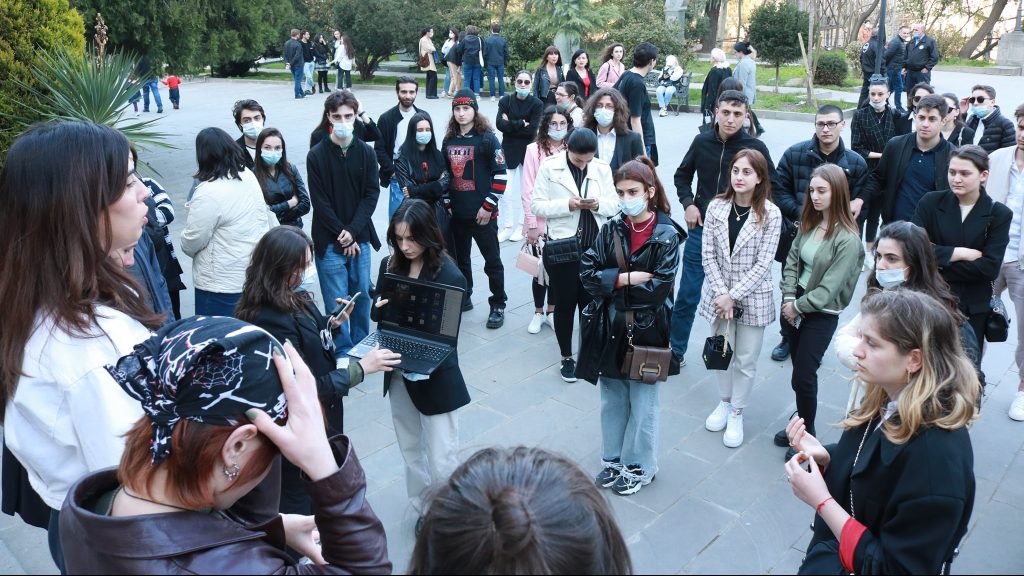
On April 17, 2022, students gathered in the courtyard of TSU’s First Building. They stated that out of 24,000 students enrolled at the university, 9,600 were from the regions, and about half of them actively supported the demand for hybrid learning. After unsuccessful communication with the administration, another protest was held on April 20. The banners on the steps of the First Building read: “Don’t leave us without education” and “Decent housing for students.”
On May 11, the Ministry of Education also called on TSU to complete the academic year in hybrid mode. That same day, students met with the university administration. After a tense, hours-long meeting, the students’ demands were met — Rector Giorgi Sharvashidze issued a decree allowing hybrid learning to resume on May 13.
However, students soon complained that many lecturers were not conducting classes in a hybrid format due to technical or internet-related issues. They said the decision to let each faculty choose its own method created chaos and confusion among both students and instructors.
On May 31, the university administration announced that students would be able to take exams in two additional cities — Kutaisi and Akhaltsikhe. Students argued that this was still insufficient, as final exams at TSU were scheduled to begin on June 18.
They resumed protests, demanding that final exams be held online. On June 3, they occupied the university’s chancellery and blocked the corridor. “The chancellery will not be vacated until we receive concrete answers,” the students declared.
In addition to completing the semester remotely, their main demands were:
- Construction of a student dormitory
- Financial transparency at TSU
- Prioritization of students in university policy
Later that day, TSU’s Academic Council issued a statement saying: “Final exams must be conducted in person, as this is the fairest form of knowledge assessment.”
By June 6, the list of demands had shifted. While the initial focus was on holding online exams, the main demand now became the resignation of Rector Giorgi Sharvashidze and reform of the rector election process. Students called for the rector to be elected directly and secretly by the majority of the university’s professors, instead of by the 38-member Academic Council.
After several weeks of protest, on June 10, clashes broke out between students and university staff inside the First Building. Students attempted to occupy the rector’s office and had to break through a human chain formed by security guards. During the confrontation, Ramaz Khomeriki, dean of the Faculty of Exact and Natural Sciences, was physically assaulted.
According to the university’s press office, several people were injured — four security guards were taken to the hospital, and another staff member received medical care on-site. Students occupied the rector’s office and spent nights there.
On June 11, the organizers of the protest stated that Khomeriki had provoked the incident by actively defending the rector’s office. “We did not intend for events to unfold this way. The student movement apologizes for exceeding the limits of freedom of protest,” they wrote. Their banners read: “Fight for education” and “Decent housing for students.”
By June 13, the demands were again updated. Students now sought:
- A meeting with Minister of Education and Science Mikheil Chkhenkeli
- Construction of dormitories
- Changes in exam formats
- The rector’s resignation and reform of the election process
- Financial transparency
TSU administration representative Nata Asatiani told Radio Free Europe/Radio Liberty that online exams would not be allowed, citing the need to ensure educational quality and fairness for students who had already rented apartments in Tbilisi to take in-person exams. She added that about 50 spots were available at the Lisi dormitory, where students facing housing difficulties could stay free of charge during the exam period.
On June 25, students left the rector’s office, saying that some of their demands had been met. In a statement, the student movement “Fight for Education” noted that their months-long protest had achieved tangible results — hybrid learning was partially implemented (albeit with systemic flaws), dormitory accommodation was made free for the current semester, two additional exam centers were opened, and the third building of the Lisi dormitory was reopened and partially equipped. They also said meetings were held with state agencies and the university to discuss ongoing issues.
Later, the group renamed itself the “May Student Movement.”