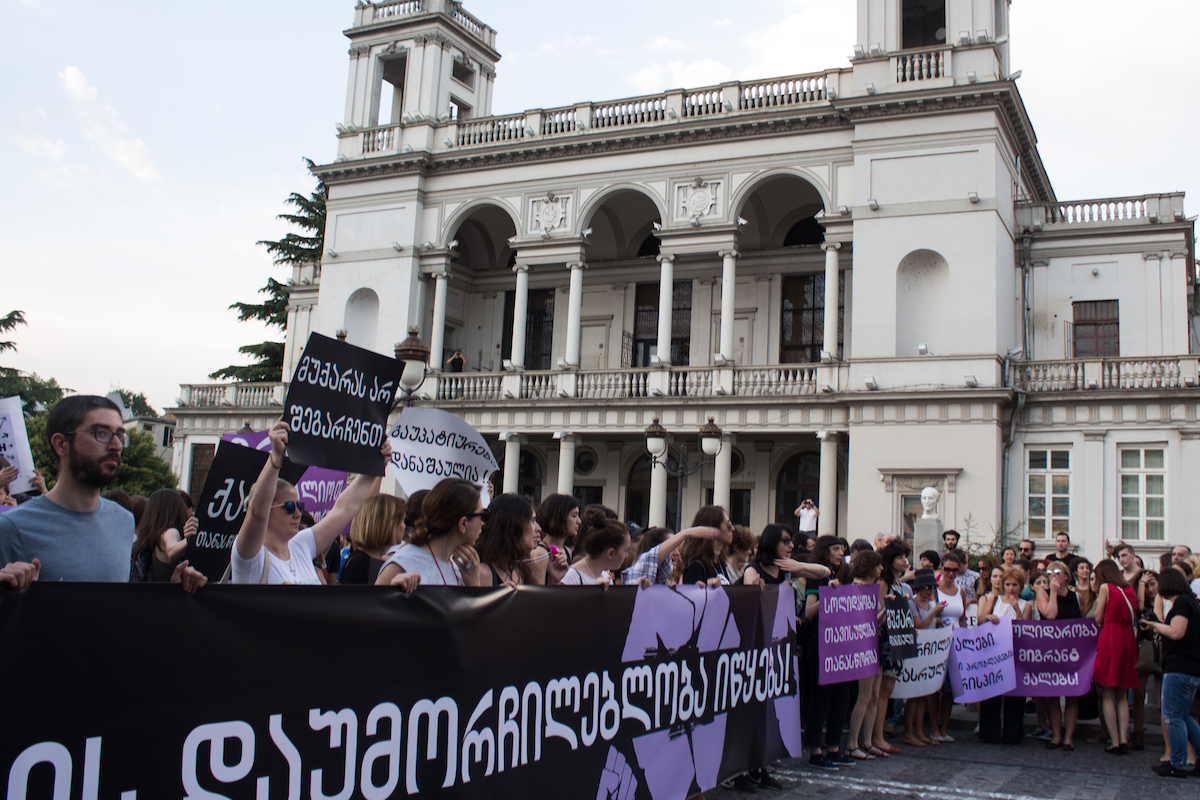
Women’s march against violence

2017

This AI-generated translation may not be completely accurate.
Women’s march against violence
On July 16, 2017, members of the “Georgian March” threatened Georgia’s UN Youth Delegate, Tatia Dolidze, with gang rape in the comments under her Facebook post. On July 17, the Ministry of Internal Affairs launched an investigation under Article 151 of the Criminal Code (threat).
In response to these threats, on July 19 the Women’s Movement organized a march in Tbilisi. “Threats and hatred will not silence us! We will not tolerate oppression and violence!” — they wrote in the event announcement, outlining their demands:
- Punish the perpetrators who threatened a woman with gang rape.
- Adopt a law against sexual harassment.
- The government and political parties must openly condemn violence and fascism.
- The media must stop spreading hate speech and refrain from giving platforms to people who promote violence.
The march started at the same location where the “Georgian March” had taken place a few days earlier. The banner at the front read: “Women’s disobedience begins.” Others read: “Women’s struggle begins,” “We will not forgive threats,” “Rape is a crime,” “We will not tolerate it anymore.”
About 15 NGOs joined the protest. Participants argued that the threats against Tatia Dolidze went far beyond online bullying and constituted a horrifying act of intimidation. “This is an attempt to silence women, to stop them from expressing their opinions. But women’s active participation is vital for our country’s development,” said organizer Baia Pataria, who emphasized that despite recent efforts, the state was still failing to curb the wave of gender-based violence.
The Women’s Movement has been organizing protests since 2014, but the fact that violence against women still hasn’t become a broadly recognized issue — as reflected in the low turnout at demonstrations — indicates, according to organizers, that society either doesn’t perceive it as a serious problem or is unwilling to acknowledge it. This indifference, they said, often extends to law enforcement’s response as well.
The Ministry of Internal Affairs questioned several members of the “Georgian March” regarding the threats against Tatia Dolidze, but no final decision or outcome of the investigation was made public.