Against Gorbachev’s January 7 Decree
1991


This AI-generated translation may not be completely accurate.
Against Gorbachev’s January 7 Decree
On January 7, 1991, Soviet President Mikhail Gorbachev issued a decree concerning the South Ossetian Autonomous Region that provoked a strong reaction in Georgia. The document declared that the decision of the Supreme Council of the Georgian SSR to abolish South Ossetia’s autonomy violated the Soviet Constitution and called on the public to disregard the Georgian government’s decision. Gorbachev also demanded the withdrawal of armed forces from South Ossetia within three days, allowing only units of the Soviet Ministry of Internal Affairs to remain.
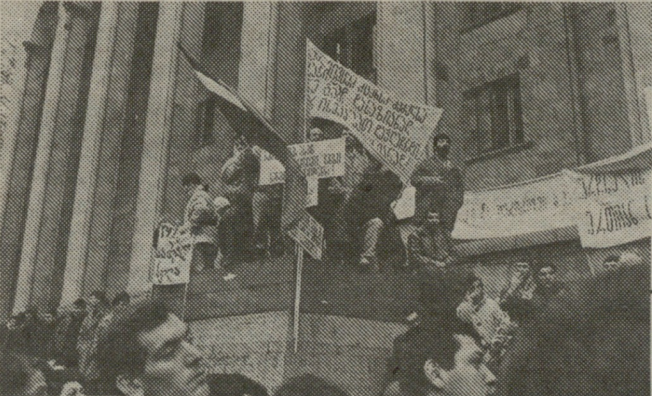
On January 9, employees of the Central Committee publishing house held a rally, where the director, typesetters, linotypists, and other staff denounced the decree as blatant interference in Georgia’s sovereignty and a direct incitement to conflict between Georgians and Ossetians. A similar rally took place at the newspaper publishing building, and participants sent an appeal to Gorbachev.
The following day, professors, teachers, and students gathered at Tbilisi State University, likewise condemning the decree as “gross, unconstitutional interference in the internal affairs of sovereign Georgia.” Representatives of the “Svaneti” organization, including around a thousand people from Svaneti, also joined. Protesters declared that Georgia faced a stark choice: freedom or slavery.
The demonstrators called on Ossetians living in Georgia to stand with Georgians in Samachablo and “urge their misguided brothers toward wisdom.” They demanded that Gorbachev revoke the January 7 decree, warning that otherwise “the entire Georgian nation would declare national disobedience.” Appeals with similar demands were widely published in the press.
On January 10, a hunger strike began in Moscow at the Permanent Mission of the Georgian Council of Ministers. Participants—including Supreme Council deputy Valter Shurgaia, journalist Gia Tasoev, and physician Eter Shukvani—signed a statement protesting “the threat of dictatorship and the President’s January 7 decree.” In total, 43 people joined, including Georgians, Ossetians, and Kurds, as well as doctors, workers, scientists, housewives, and two members of the Supreme Council. Within days, five ended their protest, and one was hospitalized.
On January 11, an extraordinary session of the district consumer cooperative union dissolved the body and denounced Gorbachev’s decree as a provocation and an assault on Georgia’s sovereignty. Members declared that Georgians and Ossetians must not be drawn into fratricidal war and demanded punishment for those inciting hostility between the two peoples. They appealed to Zviad Gamsakhurdia, Chairman of the Supreme Council of Georgia, declaring that anyone obstructing legality in Shida Kartli and Samachablo or threatening Georgia’s territorial integrity was an aggressor whose actions amounted to political assault. They also sent a protest letter to Gorbachev, demanding the annulment of what they called a discriminatory and legally baseless decree.
According to hunger strike participant Tina Imnadze, the protest was suspended “after representatives of the USSR parliament arrived in Tbilisi.” The strike officially ended on January 17, though demonstrations resumed on March 12 with four demands:
- An end to “the terror carried out by Ossetian extremists against the Georgian population in Samachablo” and their immediate disarmament.
- An end to the supply of arms to Ossetian extremists by the Soviet Army.
- An end to the mass media’s “shameful campaign of disinformation and slander against the Georgian people.”
Protesters argued that Gorbachev’s decree was part of a broader anti-Georgian campaign encouraged by Moscow, which opposed Georgia’s determination to restore its state independence. They viewed the decree as a step toward dictatorship and an assault on people’s rights and freedoms.
Among the individual protesters was the poet Badri Gugushvili, who supported the general demands but added two further points: “Under no circumstances should additional Soviet troops be deployed in Georgia,” and “The forced conscription of Georgian youth into the Soviet Union’s occupying, imperial army must cease.” Gugushvili sent his demands not only to Gorbachev, but also to the United Nations, the Georgian Supreme Council, Georgian television, and the newspaper Literary Georgia.