Protests Against the War in South Ossetia

1991

This AI-generated translation may not be completely accurate.
Protests Against the War in South Ossetia
On January 5–6, 1991, the Georgian police were deployed in Tskhinvali to disarm Ossetian armed groups, which led to a confrontation. The western part of the city was controlled by Ossetians, while the eastern part was under Georgian control.
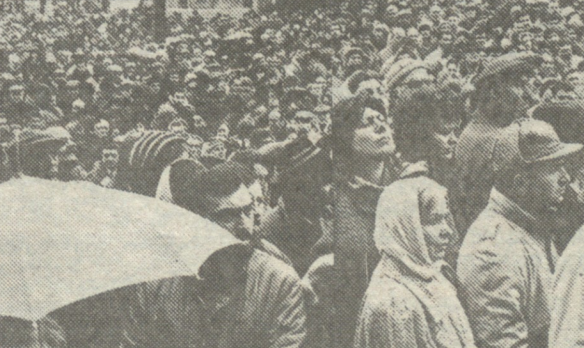
On January 10, a massive rally was organized by teachers and students from Tbilisi near the government building (now the parliament building). In his speech, the Chairman of the Supreme Council of the Georgian Republic, Zviad Gamsakhurdia, stated that the situation in Shida Kartli was being controlled by the Georgian militia, and that Afghan war veterans were present, “doing everything in their power to stabilize the situation.” Paratroopers sent by the command of the Transcaucasian Military District were also deployed in Shida Kartli to protect military facilities.
In addition to informing the public, the rally aimed to call on “all non-Georgians living in the republic” to demonstrate, through action rather than words, that they stood with the Georgians. On the same day, a second rally took place at the same location, initiated by the city’s non-Georgian population, expressing their desire to stand by the Georgians and sending a protest letter to the President of the USSR.
According to the Ministry of Internal Affairs’ press center, on January 15–16, “extremists fired bullets all night” at the Georgian militia’s stationed locations (the militia being the former name of the police). The Ministry stated that “there are forces who do not want stabilization in the region.”
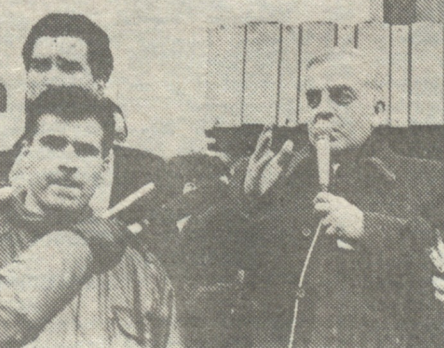
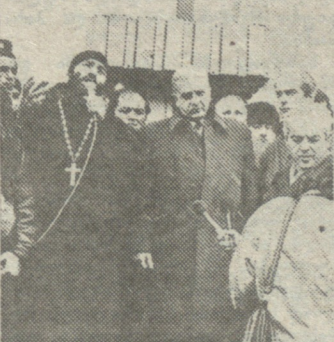
Due to the ongoing situation in Shida Kartli, on January 17, members of the Supreme Council—Viktor Domukhovski, priest Father Archil, and architect Violeta Alborova—addressed the rally near the government building. They demanded an end to the bloodshed in Samachablo and condemned the actions of “Ossetian extremists and their instigators and protectors in the center.” Rally participants expressed solidarity with the peoples of Lithuania, Latvia, and Estonia, who had recently faced Soviet military aggression: on January 8–9, 1991, Soviet troops entered Lithuania and demanded the annulment of its March 11, 1990 declaration of independence, and on January 11–13, 1991, Soviet army units attacked various facilities in the Baltic states.
Speakers at the rally praised the creation of a delegation representing the Georgian, Ossetian, Armenian, and Russian populations to meet with R. Nishanov, Chairman of the Supreme Soviet’s Nationalities Committee, who had arrived in Tbilisi. The delegation’s goal was to protest Moscow’s interference in Georgia’s internal affairs and the biased reporting on the events in Shida Kartli.
Although Zviad Gamsakhurdia was Chairman of the Supreme Council at the time, he used the January 17 rally as a platform to warn that “extremists” were escalating the situation. In his speech, he emphasized that no one would allow the extremists’ plan to alter the political map of the republic.
The same rhetoric continued during the February 18 rally. Speakers stated: “Yes, we condemn the use of force by the military against our citizens, but we cannot ignore the artificially provoked conflicts.” They argued that such clashes had been staged by the Kremlin and the “Mkhidroni” (the Georgian militia), posing a threat to the parliament and government elected by the people and potentially replicating the Baltic events in Georgia.
On March 5–6, ethnic Ossetians in Tbilisi gathered for a “peacekeeping mission,” departing for Tskhinvali on about 30 buses, believing their presence could help resolve the conflict. One citizen told the newspaper Akhalgazrda Iverieli before departure: “A handful of Ossetian extremists will not be able to do anything if met by a large number of peace-loving Ossetians.”
On March 7, “refugees from Samachablo” gathered near the government building in Tbilisi, demanding that all illegal armed groups in Samachablo immediately surrender their weapons. They called for conditions enabling the safe return of displaced persons to Tskhinvali and for Georgians to have the legal right to live and work peacefully.
In response to the situation in Shida Kartli and Samachablo, members of the God’s Children Union began a hunger strike on April 12 at the Union’s residence in Gori. Among the hunger strikers was Elguja Kasradze, chairman of the regional organization in Kartli and a first-group blind invalid. The hunger strikers declared: “Invalids are no longer spared in Samachablo; one Georgian invalid has already been killed, and others are being forced to leave their homes.”
On May 7, members of the God’s Children Union began a three-day protest sit-in at the permanent representative office of the Georgian Republic in Moscow. They protested Moscow’s interference in Georgia’s internal affairs regarding the Samachablo conflict and the violation of invalids’ rights by Ossetian extremists. They sought meetings with both the central authorities in Moscow and leaders of the democratic movement. On May 8, they met with Georgia’s Minister of Foreign Affairs, Giorgi Khoshtaria; on May 9, they spoke by phone with the U.S. Ambassador to the USSR, Jack Matlock, through the Union’s president, Zaza Sikharulidze. On May 10, they presented their demands at a press conference organized for Soviet and foreign journalists, as well as members of the diplomatic corps accredited in Moscow.