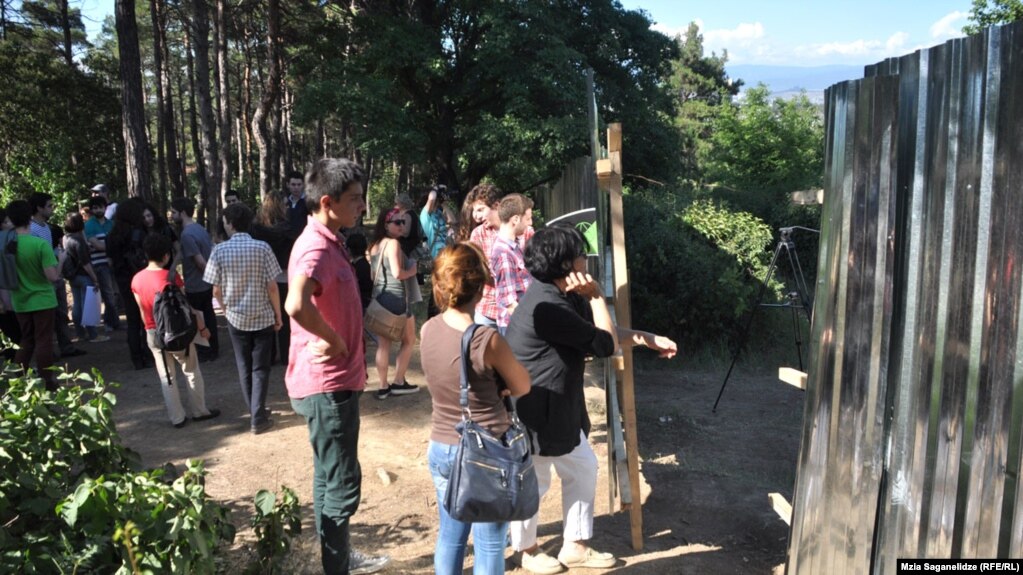
Protest to defend the “Squirrel Zone”

2013

This AI-generated translation may not be completely accurate.
Protest to defend the “Squirrel Zone”
On July 30, 2013, residents of Tbilisi began mobilizing on the slope of Turtle Lake, in the area known as the “Squirrel Zone.” The protest to defend the territory began after representatives of the company Kolorit started uprooting trees to make way for the construction of a “family-style recreational restaurant” in the middle of a recreational zone. The site was fenced off, displaying a banner with an image of the planned restaurant. Environmental activists, representatives of various organizations, and supporters of Turtle Lake’s recreational area gathered to protest the planned construction.
Representatives of the company that owned the land claimed they possessed all the necessary documents confirming their right to build on the site.
Erekle Urushadze, from Transparency International Georgia, explained that the area around Turtle Lake was designated as a landscape-recreational zone, meaning that construction there should be strictly prohibited. However, the Tbilisi City Hall had reclassified the central part of the territory, granting it a lower protection status, which automatically allowed the owner to start construction.
“In 2011, City Hall sold this plot through an auction to the company Otium Ltd., which was connected to then–Member of Parliament from the ruling party, Archil Gegenava. Otium was owned by M Group, a company belonging to Mr. Gegenava. Later, the property was sold to Kolorit Ltd., but the situation remained the same because one of Kolorit’sowners was Archil Gegenava’s brother, Andro Gegenava,” said Urushadze.
City Hall maintained that no trees were cut down in the area and that it had not granted any such permit, claiming instead that only a few plants had been relocated.
Once the protest was announced for July 30 and people gathered at the site, representatives of the construction company replanted the uprooted saplings and stated that the issue would be resolved in court. However, before the court process was completed, on September 23, workers again began removing plants from the site. The civic movement Guerrilla Gardening Tbilisi immediately responded and resumed protests.
The guerrilla gardeners and their supporters blocked the area with cars and tents, preventing a truck loaded with plants from leaving. Slogans such as “Don’t Cut Down” appeared on the fence. The protesters demanded that the bushes be replanted in the “Squirrel Zone,” while representatives of Kolorit claimed they were transporting the plants to the grounds of Tbilisi State University’s High-Rise Building and would not return them. The company warned that if the trees were not moved quickly, they would dry out on the truck, for which the protesters would be held responsible.
Activists argued that their main grievances were not directed against the investor but against City Hall and the City Council, which had authorized the project. Despite public opposition, Kolorit Ltd. proceeded with construction, and eventually, the restaurant Otium opened on the site.