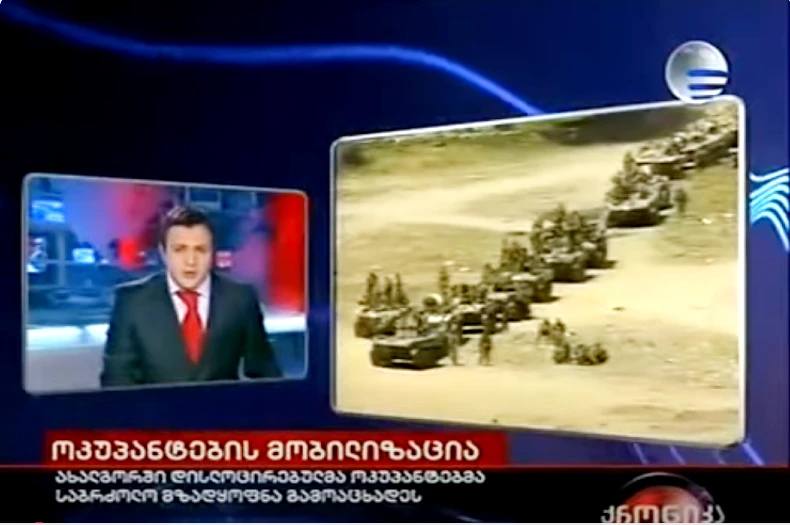
Protest against the simulated Kronika

2010

This AI-generated translation may not be completely accurate.
Protest against the simulated Kronika
On March 13, 2010, the television channel Imedi aired a program titled Special Report, which featured a fabricated version of its news broadcast Kronika, depicting a renewed war between Georgia and Russia.
The program consisted of two parts: a talk show and a simulated news broadcast. At the start, the talk show host introduced the segment with a brief statement, warning viewers that what followed was a fictional scenario: “Have you ever thought about the end of Georgia’s statehood? …We would like to present a special, simulated edition of Kronika.”
The fake news segment that followed used archival footage from actual past events — including war scenes, protests being dispersed, and bloodied patients in hospitals. The broadcast aired during Imedi’s regular prime-time news slot, and viewers who tuned in a few minutes late did not realize that the events being reported were fictional.
Before the program had even ended, groups of people began gathering outside Imedi’s headquarters to protest. Some shouted at participants of the broadcast as they exited the building, criticizing them for not clarifying on air that the events were made up. Later, politicians also joined the protesters.
The Georgian Young Lawyers’ Association issued a statement accusing Imedi of violating both the Law on Broadcasting and the Georgian Broadcasters’ Code of Conduct.
About an hour and a half after the broadcast ended, Imedi aired a scrolling text on screen that read: “We apologize to the public for the simulated edition of Kronika shown in Special Report, which did not reflect reality.”
The fake broadcast caused widespread panic across the country. In Tbilisi and other regions — especially near the conflict zones — people fled their homes, and some residents sought refuge in nearby forests. Long lines formed at gas stations and grocery stores, and the emergency medical service was overwhelmed with calls, forcing it to operate in emergency mode.
The protests continued the next day. Students from the journalism faculty of Tbilisi State University demonstrated against Kronika. They distributed printed copies of Article 13 of the Broadcasters’ Code of Conduct, which they believed Imedihad violated. The article states: “To avoid misleading the audience, a broadcaster must refrain from using dramatizations and staged reconstructions in news or public affairs programs, or must clearly identify them as such. Any broadcast reconstruction of documentary or real events must be explicitly labeled.”
Public outrage extended to social media, where users replaced their Facebook profile pictures with Imedi’s crossed-out logo. Despite the protests, Imedi’s director Giorgi Arveladze announced that he would neither resign nor make staffing changes. “Our goal was not to panic the public,” he said, “but to show them a scenario that Russia has prepared.”
Amid the backlash, only one journalist from Imedi, Iase Tsintsadze of the program Journalist’s Diary, resigned from the channel.